
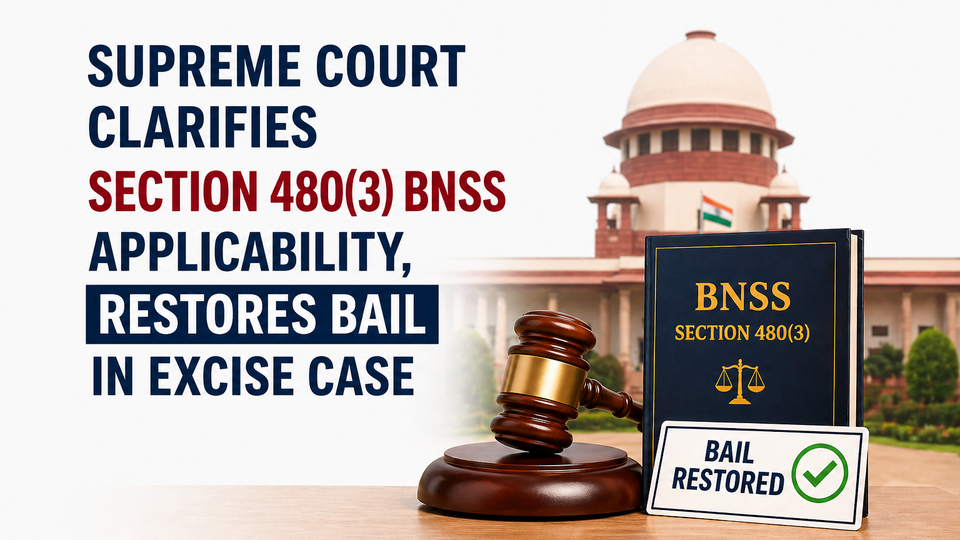
Supreme Court Clarifies Section 480(3) BNSS Applicability, Restores Bail in Excise Case
Supreme Court rules that Section 480(3) Bharatiya Nagarik Suraksha Sanhita conditions cannot apply to offences punishable up to 7 years, sets aside MP High Court bail cancellation order.
The Supreme Court of India has ruled that the stringent conditions under Section 480(3) of the Bharatiya Nagarik Suraksha Sanhita (BNSS) cannot be imposed in non-bailable offences carrying a maximum punishment of up to seven years. The Court set aside an order of the Madhya Pradesh High Court which had cancelled the bail of an accused by wrongly invoking these provisions.
Bench and Judgment Overview
The ruling was delivered by a bench comprising Justice J.K. Maheshwari and Justice Atul S. Chandurkar. The Court held that the High Court had erred in applying Section 480(3) BNSS conditions to an offence that did not meet the statutory threshold for such restrictions.
Case Background
The matter arose from a case under the M.P. Excise Act, 1915, involving possession of illegal liquor. The offence in question was non-bailable but carried a maximum punishment of only three years.
Initially, the High Court had granted bail under Section 480 Bharatiya Nagarik Suraksha Sanhita but imposed additional conditions drawn from Section 480(3). These conditions typically require the accused to:
- Appear before the court as directed
- Refrain from committing similar offences
- Avoid influencing witnesses or tampering with evidence
Subsequently, the State sought cancellation of bail, alleging that the accused had committed another offence involving possession of 72 bulk litres of illegal liquor, thereby violating the imposed conditions.
Accepting this argument, the High Court cancelled the bail, relying on the alleged breach of Section 480(3) conditions.
Table of Contents
Supreme Court’s Analysis
The Supreme Court found this approach legally flawed. It clarified that Section 480(3) BNSS applies only to:
- Offences punishable with seven years or more, or
- Specific serious offences under designated chapters involving grave criminal conduct such as conspiracy or abetment
Since the offence in question carried a maximum punishment of three years, the imposition of Section 480(3) conditions was itself incorrect. Consequently, any alleged violation of those conditions could not form the basis for cancelling bail.
Key Observation by the Court
The bench categorically held:
“…since the punishment for subsequent offence is less than five years, the conditions as stipulated in Section 480(3) Bharatiya Nagarik Suraksha Sanhita are not imposable. Therefore, at present, cancellation of bail on account of involvement in the subsequent offence solely based on Section 34(2) of the M.P. Excise Act, 1915, is not justified.”
Legal Significance
This judgment reinforces the principle that bail conditions must strictly align with statutory provisions. Courts cannot impose stricter conditions than what the law permits, especially in cases involving offences with relatively lesser punishment.
The ruling is expected to have broader implications for bail jurisprudence under the BNSS, ensuring that lower courts exercise caution while applying enhanced restrictions meant only for serious offences.
Outcome
Allowing the appeal, the Supreme Court set aside the High Court’s order and restored the bail granted to the accused, emphasizing adherence to the correct statutory framework.
LATEST POSTS: