
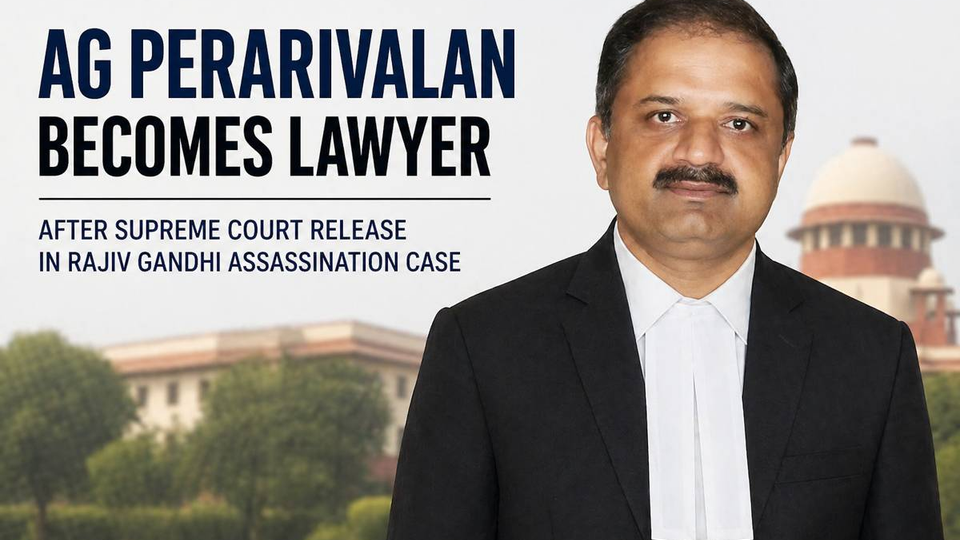
AG Perarivalan Becomes Lawyer After Supreme Court Release in Rajiv Gandhi Assassination Case
AG Perarivalan, one of the convicts in the assassination of former Prime Minister Rajiv Gandhi, has formally entered the legal profession after his release by the Supreme Court in 2022. His journey from death row convict to a practicing advocate marks a remarkable chapter in India’s legal and criminal justice landscape.
Perarivalan was enrolled as an advocate with the Bar Council of Tamil Nadu and Puducherry during an enrolment ceremony held in Chennai on April 27, 2026. He is now eligible to practice before the Madras High Court.
Background: Conviction and Death Sentence
Perarivalan was convicted under the Terrorist and Disruptive Activities (Prevention) Act (TADA) for his role in aiding the making of the bomb used in the assassination of Rajiv Gandhi. Notably, he was only 19 years old at the time of conviction. A special court sentenced him to death, which was upheld by the Supreme Court in 1999.
Subsequently, his review petition was dismissed, and mercy petitions filed before the Governor and later the President of India under Article 72 of the Constitution were rejected in 2011.
Table of Contents
Commutation and Legal Battle
In 2014, the Supreme Court commuted his death sentence to life imprisonment, citing undue delay in deciding his mercy petition. Following this, Perarivalan pursued remission through constitutional remedies.
On September 6, 2018, he submitted an early release application to the Governor under Article 161 of the Constitution. Shortly thereafter, on September 9, 2018, the Tamil Nadu Cabinet recommended remission of his sentence and his immediate release. However, the Governor kept the matter pending for an extended period.
When no decision was forthcoming, Perarivalan approached the Supreme Court in September 2018. The Court directed the Governor to decide the plea as he “deemed fit.” Despite the State Cabinet’s recommendation, the Governor referred the matter to the President, stating that the latter was the competent authority.

Supreme Court Invokes Article 142
On May 18, 2022, a Supreme Court bench comprising Justices L Nageswara Rao, BR Gavai, and AS Bopanna exercised its extraordinary powers under Article 142 of the Constitution to order Perarivalan’s release. The Court noted the “inordinate delay” by the Governor in deciding his remission plea under Article 161 as a key ground for granting relief.
Perarivalan had spent over 32 years in prison at the time of his release.
Academic Achievements and Legal Career
During his incarceration, Perarivalan demonstrated a strong commitment to education. He completed Bachelor of Computer Applications (BCA) and Master of Computer Applications (MCA) degrees from Indira Gandhi National Open University, along with seven diploma courses. He also secured a gold medal for a diploma course from Tamil Nadu Open University.
After his release, he pursued a Bachelor of Laws (LLB) degree from Dr BR Ambedkar Law College in Karnataka, completing it in 2025. In the same year, he cleared the All India Bar Examination, thereby becoming eligible for enrolment as an advocate.
Motivation to Join Legal Profession
Reflecting on his journey, Perarivalan stated that his prolonged legal battle inspired him to study law. He highlighted that his lack of legal knowledge earlier had created several challenges and placed him in an unfavourable position during the course of his case.
He has expressed a clear intention to focus on cases involving the death penalty and human rights, drawing from his own experiences within the criminal justice system.
Conclusion
Perarivalan’s transition into the legal profession underscores the transformative potential of the justice system, while also raising important questions about delays in executive decision-making under Articles 72 and 161 of the Constitution. His case remains a significant precedent on the exercise of judicial powers under Article 142 to ensure complete justice.
LATEST POSTS: