

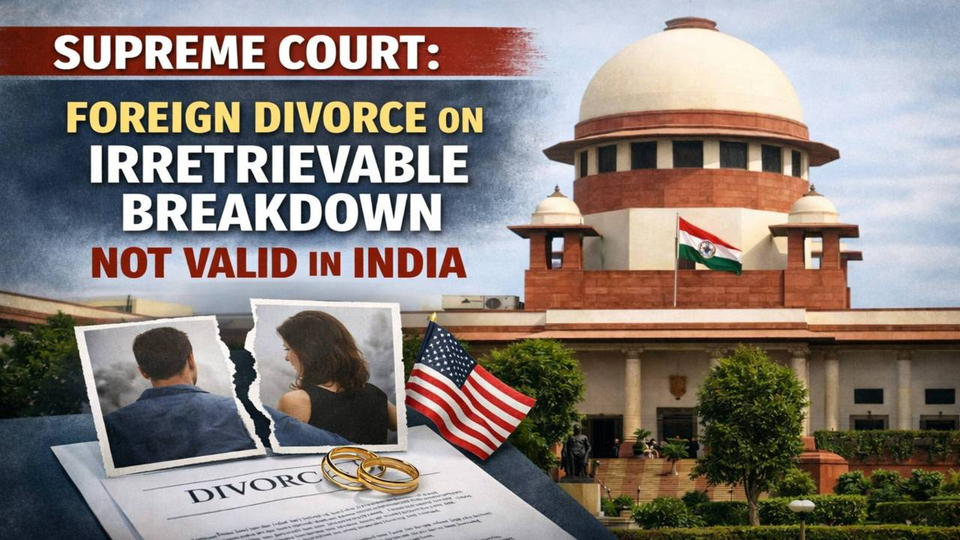
Supreme Court’s Landmark Verdict on Foreign Divorce: Irretrievable Breakdown Not Valid in India
The Supreme Court of India in Kishorekumar Mohan Kale v. Kashmira Kale clarified the legal position regarding the enforceability of foreign divorce decrees in India. The Bench comprising Justice Abhay S. Oka and Justice Ujjal Bhuyan held that a foreign divorce granted on the ground of “irretrievable breakdown of marriage” is not valid under Indian law.
Table of Contents
Background of the Case
The case involved a matrimonial dispute where one of the parties obtained a divorce decree from a foreign court. The decree was granted on the ground of irretrievable breakdown of marriage, a concept widely accepted in several foreign jurisdictions. However, the opposing spouse challenged the validity of this decree before Indian courts, arguing that such a ground is not recognized under Indian matrimonial statutes.
The matter eventually reached the Supreme Court, raising important questions about the recognition and enforcement of foreign judgments in matrimonial disputes involving Indian citizens.
Key Legal Issues
The primary issue before the Court was whether a foreign divorce decree granted on a ground not recognized under Indian law could be enforced in India. The Court also examined the applicability of statutory provisions governing foreign judgments.
Statutory Framework Considered
The Court extensively analyzed Section 13 of the Code of Civil Procedure, 1908, which lays down when a foreign judgment is considered conclusive in India. As per this provision, a foreign judgment is not binding if:
- It is not given on merits
- It is passed without jurisdiction
- It is opposed to natural justice
- It is obtained by fraud
- It is founded on a breach of Indian law
The Court emphasized that a decree based on a ground not recognized by Indian matrimonial law would fall within the exceptions under Section 13.
Additionally, the Court examined the provisions of the Hindu Marriage Act, 1955, which specifies limited grounds for divorce such as cruelty, desertion, and adultery. Importantly, “irretrievable breakdown of marriage” is not included as a statutory ground under the Act.
Supreme Court’s Observations
The Bench categorically held that:
“A foreign divorce decree based on a ground not recognized under Indian law cannot be enforced in India.”
The Court further observed that merely obtaining a decree from a foreign court does not automatically make it valid in India. For recognition, the decree must satisfy all the requirements laid down under Section 13 CPC.
The judges stressed that parties cannot circumvent Indian matrimonial law by seeking divorce in foreign jurisdictions on grounds unavailable in India.
Final Decision of the Court
The Supreme Court refused to recognize the foreign divorce decree obtained on the ground of irretrievable breakdown of marriage. It held that such a decree is unenforceable in India as it does not conform to the statutory framework governing matrimonial disputes.
The Court thus upheld the challenge to the validity of the foreign decree and reaffirmed that Indian law will prevail in determining marital status where parties are governed by Indian statutes.
Irretrievable Breakdown and Article 142
While discussing the concept of irretrievable breakdown, the Court clarified that although the Supreme Court itself has the power to dissolve marriages on this ground under Article 142 of the Constitution to do “complete justice,” such power is exclusive to the apex court.
Foreign courts do not have the authority to grant divorce on this ground in a manner that would be automatically recognized in India.
Significance of the Judgment
This ruling has far-reaching implications:
- It reinforces the supremacy of Indian matrimonial law over foreign decrees
- It protects spouses from unilateral or ex parte foreign divorces
- It ensures strict compliance with Section 13 CPC for recognition of foreign judgments
- It discourages forum shopping in matrimonial disputes
Conclusion
The Supreme Court’s ruling in Kishorekumar Mohan Kale v. Kashmira Kale is a landmark decision that strengthens the legal safeguards surrounding matrimonial disputes involving foreign jurisdictions. By refusing to recognize foreign divorce decrees based on irretrievable breakdown, the Court has upheld the integrity of Indian statutory law and ensured fairness in cross-border matrimonial conflicts.
READ JUDGEMENT
RECENT POSTS
- Supreme Court Upholds Murder Conviction in Matrimonial Home Death Case, Draws Adverse Inference Under Section 106 Evidence Act

- Delhi High Court Dismisses PIL Seeking Deregistration of AAP, Disqualification of Arvind Kejriwal From Elections

- Justice Swarana Kanta Sharma Recuses From Delhi Excise Policy Case After Initiating Contempt Against Arvind Kejriwal, AAP Leaders

- Supreme Court Restores Kuldeep Sengar’s Life Sentence in Unnao Rape Case, Sets Aside Delhi HC Order Suspending Sentence

- Frictionless Relationship Between Bar and Bench Furthers Justice: Supreme Court Closes Contempt Case Against Yatin Oza
- Political Victimisation Claim: Punjab Minister Sanjeev Arora Seeks Parity With BJP MPs In Plea Against ED Arrest Before P&H High Court