
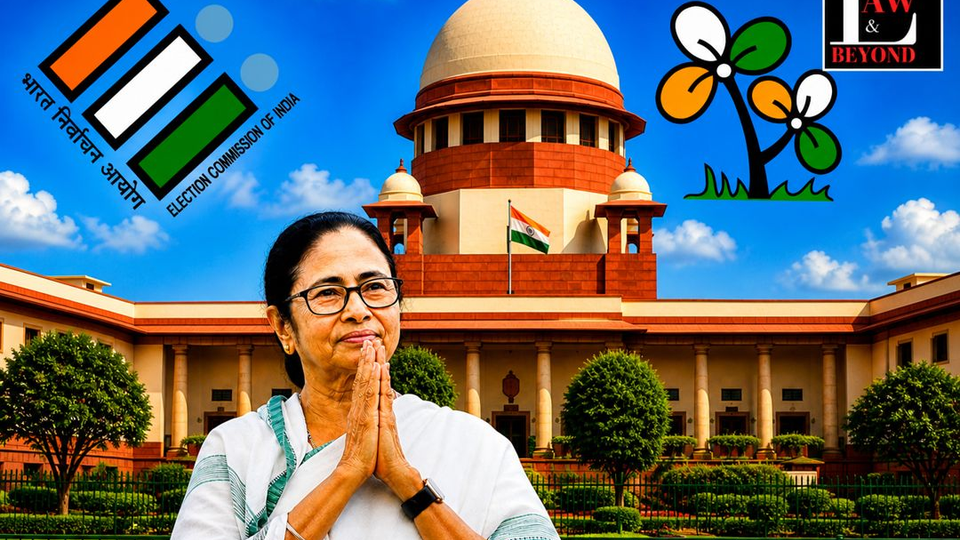
Breaking Supreme Court Order on TMC Plea: Bengal Vote Counting to Follow ECI Circular Strictly
Ahead of the West Bengal Assembly Elections 2026 vote counting, the Supreme Court on May 2 declined to pass further directions in a plea filed by the All India Trinamool Congress (AITC) challenging the role of Central government personnel in the counting process. The Court emphasized strict adherence to the Election Commission of India (ECI) circular dated April 13, 2026.
A special Bench of Justice PS Narasimha and Justice Joymalya Bagchi observed,
“No further orders are necessary except to reiterate the statement of Mr. Naidu (for ECI) that the circular dated April 13th 2026 will be implemented in letter and spirit.”
The matter was listed urgently as vote counting for the West Bengal elections is scheduled to begin at 8 AM on May 4, 2026.
Table of Contents
Case Background: TMC Challenges Counting Staff Composition
The case, All India Trinamool Congress v. Election Commission of India (Diary No. 26799/2026), arose from a communication issued by the Additional Chief Electoral Officer, West Bengal. The communication mandated that:
“at least one among the Counting Supervisor and Counting Assistant at each table shall be a Central Government/ Central PSU employee.”
The Calcutta High Court, in its April 30, 2026 order, dismissed the TMC’s challenge and upheld the ECI’s authority. The High Court held:
“This Court does not find any illegality for appointing counting supervisor and counting assistant from the Central Government/Central PSU employee instead of State Government employee.”
TMC’s Key Arguments Before Supreme Court
Senior Advocate Kapil Sibal, appearing for AITC, raised serious concerns over transparency, fairness, and alleged arbitrariness in the ECI’s decision.
He argued that the circular was issued on April 13 but came to the party’s knowledge only on April 29, raising procedural concerns.
Sibal submitted:
“CEO’s communication says that there are apprehensions expressed from various quarters regarding possible irregularities in counting…They want another central govt nominee because they fear possible irregularities. That is pointing a finger at the state government…”
Questioning the lack of supporting data, he further stated:
“There must be some data. Where is the apprehension from each booth? They have not disclosed this. And why not tell us that there going to have a central government nominee?”
The plea contended that the direction violated Article 14 (equality) and raised concerns regarding Article 324 (powers of the Election Commission). It also argued that:
- Similar elections in Assam, Kerala, and Puducherry were conducted without such requirements
- The communication exceeded delegated authority under Section 19A of the Representation of the People Act, 1951
- Judicial review under Article 226 remains available despite the bar under Article 329(b)
ECI’s Assurance Before the Court

Senior Advocate Dama Seshadri Naidu, appearing for the Election Commission of India, clarified that the circular would be fully complied with.
He assured the Bench:
“We are saying that State government nominee will be there. That will be followed even before all this.”
Naidu also emphasized that the returning officer—who is a State government official—has overarching authority over the counting process. He dismissed concerns as misplaced and highlighted that counting agents of candidates would be present.
On the issue of surveillance, he stated:
“It is kept for 45 days.”
Supreme Court’s Key Observations
The Supreme Court refused to interfere with the Calcutta High Court’s ruling and reiterated the ECI’s discretion in appointing counting personnel.
Justice Bagchi observed:
“The option is open that the counting supervisor and counting assistant may be of the central government or may be of the state government. So when that option is open we can’t hold that the notification is contrary to regulations.”
He further added:
“Even if they had said that we could not have faulted them. Because regulation say that either Central Government or state government officers can be appointed.”
Justice Narasimha questioned the proportionality argument, stating:
“What is this proportionate representation concept. All of them are employees of the government.”
Conclusion: No Interference, But Strict Compliance Mandated
Recording the ECI’s assurance, the Supreme Court disposed of the plea without issuing further directions. However, it made it clear that the April 13 circular must be implemented “in letter and spirit.”
The ruling effectively clears the way for the vote counting process in the West Bengal Assembly Elections 2026, while addressing concerns over representation by reaffirming the presence of State government nominees.
LATEST UPADTES:
- Supreme Court’s Powerful Relief To Murder Convict After 22 Years In Jail; Faults Orissa HC For Rejecting Appeal On Delay
- Supreme Court Questions Delhi High Court Ruling on Low Attendance for Law Students, Seeks BCI’s Stand
- Union Cabinet Approves Key Move to Increase Supreme Court Strength to 38 Judges
- Supreme Court Clarifies Limits of Article 227: High Courts Cannot Substitute Plausible Views of Execution Courts
- Shocking Delhi Judge Death: 30-Year-Old Judicial Officer Found Dead, Family Alleges Harassment

- Breaking: Supreme Court Declines to Interfere in TMC Plea on Bengal Vote Counting, Orders Strict Compliance with ECI Circular