
Supreme Court Reserves Judgment on PIL Challenging Hanging, Weighs Humane Alternatives for Death Penalty in India
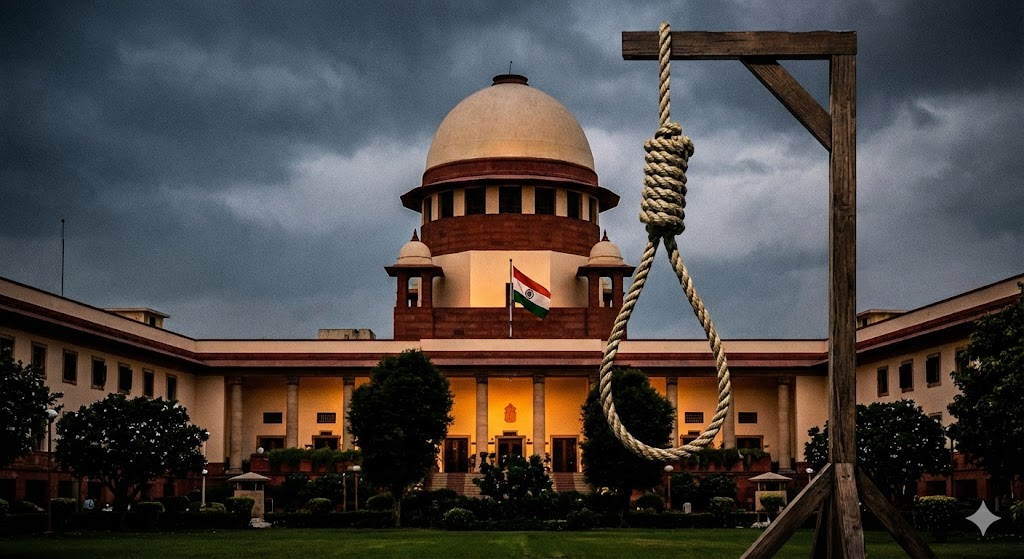
On January 22, 2026, the Supreme Court of India reserved its judgment on a public interest litigation (PIL) that challenges the constitutionality and humanity of hanging as the exclusive mode of execution in death penalty cases. The hearing, before a Bench comprising Justices Vikram Nath and Sandeep Mehta, focused on whether more “humane” alternatives—such as lethal injection—should replace the current system under Section 354(5) of the Code of Criminal Procedure (CrPC), which mandates that a person sentenced to death “shall be hanged by the neck till he is dead.”
The PIL, filed by Advocate Rishi Malhotra in 2017, argues that execution by hanging involves “prolonged pain and suffering” and violates the right to life and dignity under Article 21 of the Constitution of India. It seeks to declare Section 354(5) CrPC as ultra vires and urged the court to recognize a prisoner’s right to die with dignity—a concept drawn from jurisprudence that emphasizes humane treatment even at life’s end.
Table of Contents
Arguments for Humane Alternatives
During the hearing, Malhotra presented Law Commission of India reports and comparative data to support the adoption of alternative methods of execution such as intravenous lethal injection, electrocution, shooting, or gas chamber, methods that proponents argue lead to a quicker death. According to the petition, while a hanging execution can take more than 40 minutes to result in death, methods like lethal injection could conclude within five minutes, and shooting within a few minutes.
Malhotra urged that “At least give an option to the condemned prisoner whether he wants hanging or lethal injection… lethal injection is quick, humane and decent, as opposed to hanging, which is cruel, barbaric and lingering… for 40 minutes, the body lingers on the rope.”
Senior Advocate Meenakshi Arora, representing Project 39A, a criminal justice programme advocating for death row prisoner rights, supported the call for exploration of alternatives but cautioned that global experience—especially in the United States—shows mixed results with lethal injection. She noted: “It has been found that it’s not really successful” and recommended the formation of an expert committee to gather data and provide evidence-based recommendations.
Psychological and Practical Considerations
The Bench acknowledged concerns beyond the prisoner’s experience. Justice Mehta pointed to the psychological impact on those involved in executions, stating: “Persons who are witnessing… quite a serious thing.” This remark reflects growing judicial sensitivity to the broader moral and mental health implications of execution methods.
On the other side, Attorney General R. Venkataramani informed the Court that the Central Government is examining the issue at the highest level, with committees constituted to evaluate the matter. He reiterated the Union’s view that any decision on execution methods involves complex policy considerations. “The government is examining the issue at the highest level,” he said during the hearing.
Global Context and Constitutional Rights
The petitioner also highlighted that many countries have abandoned hanging in favour of methods perceived as more humane. Citing the United Nations Economic and Social Council (ECOSOC), the plea noted that when capital punishment is applied, it should “inflict minimum possible suffering.”
These arguments align with broader human rights discourse, including international debates on humane execution protocols. For example, in Bucklew v. Precythe, the U.S. Supreme Court acknowledged that the Eighth Amendment does not guarantee a painless death but forbids methods that add “terror, pain or disgrace” beyond what is necessary.
Next Steps and Conclusion
After hearing submissions from both sides, the Supreme Court directed all parties to file written briefs within a specified period. With the Centre indicating readiness to revisit the issue if necessary, and the Bench reserving its orders, the case represents a significant juncture in India’s jurisprudence on capital punishment.
As the court deliberates on whether hanging remains constitutionally and ethically defensible in modern India, the human rights implications and comparative global practices will be critical in shaping final determinations.
READ THIS: “Punjab & Haryana HC Denies Maintenance for Concealed Income”