

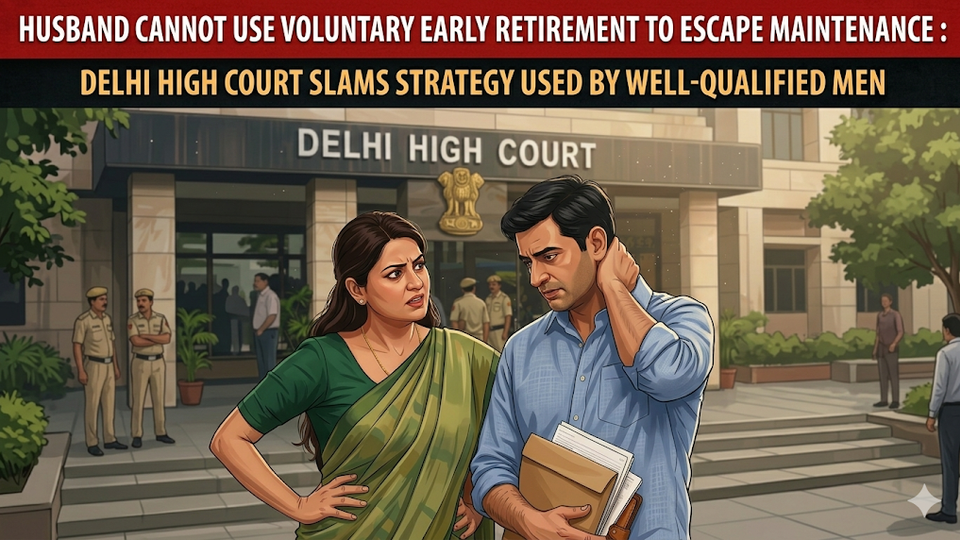
Delhi High Court: No Escape from Maintenance via Voluntary Retirement
Delhi High Court rules that husbands cannot avoid maintenance by quitting jobs or taking voluntary retirement. Earning capacity must be considered.
The Delhi High Court has held that a husband cannot evade his legal obligation to pay maintenance by opting for voluntary retirement. The Court emphasized that earning capacity—not just current income—must be considered while determining maintenance.
Table of Contents
Case Title and Bench
Case: P v. Q
Court: Delhi High Court
Judge: Justice Amit Mahajan
Facts of the Case
The petitioner, a former CRPF officer, challenged a Family Court order directing him to pay maintenance to his estranged wife and child. The Family Court had awarded ₹10,000 per month each to the wife and daughter, along with a 10% enhancement every two years.
The husband argued that he had taken voluntary retirement and was dependent solely on pension and limited agricultural income. He also contended that his wife had rental income and was therefore not entitled to maintenance.
Key Observations by the Delhi High Court
Rejecting the husband’s arguments, the Court strongly criticized the tactic of reducing income to avoid maintenance obligations:
“Just as employed wives allegedly leave their jobs to gain an upper hand in maintenance disputes, quitting of jobs is similarly a common strategy adopted by well-qualified husbands to avoid paying proper amount of maintenance as well.”
The Court further observed:
“It appears to be implausible that the petitioner would have taken retirement from his stable well-paying job without securing any other mode of income.”
Reinforcing the legal duty to maintain dependents, the Court held:
“The petitioner is thus obliged to earn and maintain his family…”
On the claim of limited income, the Court stated:
“Any assertion of the petitioner having no source of income apart from his pension pursuant to retirement cannot be accepted.”
Wife’s Financial Capacity Examined
The Court rejected the husband’s claim that the wife had sufficient rental income. It noted that the alleged income of ₹2,500–₹3,000 per month was insufficient for sustenance.
The Court also acknowledged that the wife had been living separately since 2013 due to alleged cruelty, thereby affirming her right to claim maintenance.
Legal Principles Laid Down
The judgment reiterates important principles governing maintenance law in India:
- Maintenance is a continuing legal obligation
- Voluntary retirement cannot be used to defeat maintenance claims
- Courts assess earning capacity, not just declared income
- Able-bodied individuals must make genuine efforts to earn
The Court also noted that parties often conceal their true income in matrimonial disputes, allowing courts to draw reasonable inferences.
Final Verdict
The Delhi High Court dismissed the husband’s plea and upheld the Family Court’s maintenance order. No substantial grounds were found to interfere with the quantum of maintenance awarded.
Conclusion
This ruling strengthens the legal position that maintenance obligations cannot be avoided through strategic unemployment or voluntary retirement. It reinforces that financial responsibility towards dependents is a continuing duty grounded in both law and equity.
ALSO READ: “Supreme Court Holds Foreign Divorce on Irretrievable Breakdown Not Enforceable in India”
LATEST POSTS
- Institutions Like ECI Must Function Independently: Justice BV Nagarathna Warns Against Constitutional Breakdown
- Rajasthan High Court Deletes Remarks Critical of Transgender Amendment Law, Says Epilogue Was “Added by Mistake”

- Delhi Court Grants Bail in AI Image Case Involving Narendra Modi and Shah Rukh Khan

- Supreme Court Slams West Bengal Over Attack on Judges During SIR Election Duties, Orders Central Probe

- Supreme Court Imposes ₹25,000 Costs on Centre for Unnecessary Litigation in CISF Constable Election
- Calcutta High Court Dismisses PIL Challenging ECI Transfers Ahead of West Bengal Elections