
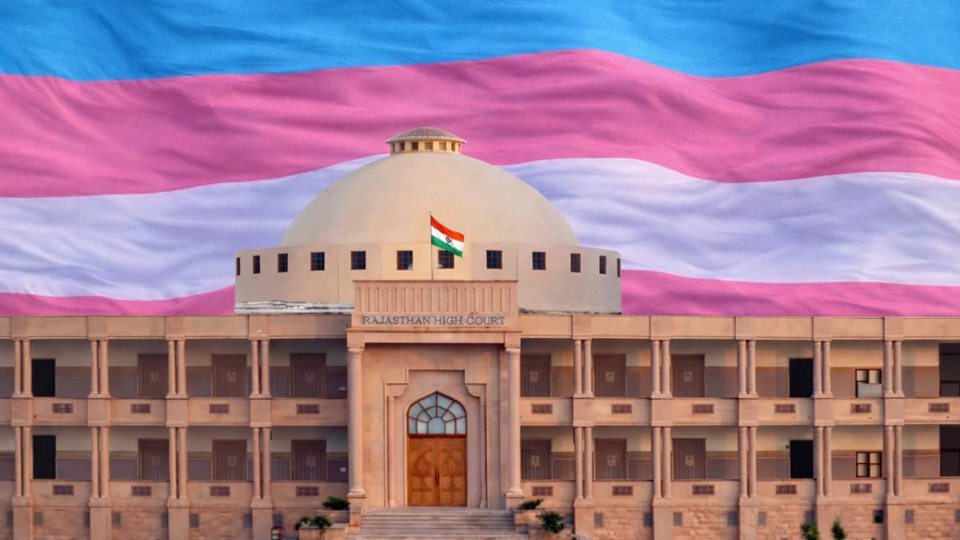
Rajasthan High Court Deletes Remarks on Transgender Amendment Law, Calls Them “Added by Mistake”
The Rajasthan High Court has withdrawn portions of its earlier judgment that were perceived as critical of the Transgender Persons (Protection of Rights) Amendment Bill, 2026, clarifying that such observations were “added by mistake.” The order was passed on April 2, 2026, in the case of Ganga Kumari v State of Rajasthan.
Background of the Case
The matter was heard by a Division Bench comprising Justices Arun Monga and Yogendra Kumar Purohit. The original judgment dated March 30, 2026, arose from a petition filed by a transgender individual challenging a 2023 Rajasthan government notification that categorized transgender persons under the Other Backward Classes (OBC) without granting separate reservation benefits.
The petitioner argued that such classification created a “meaningless illusion” and failed to provide substantive affirmative action, particularly in education and public employment.
Table of Contents
Key Directions in the March 30 Judgment
The High Court, while addressing the issue, directed the State to:
- Constitute a committee to assess the extent of marginalisation faced by transgender persons.
- Recommend appropriate measures for their upliftment.
- Provide an additional 3% weightage in marks for transgender individuals in public employment and educational admissions until a formal policy is framed.
The Bench had also criticized the State notification, calling it a “mere facade and an eyewash” that failed to translate constitutional recognition into real benefits.
Controversial Epilogue and Observations
In an epilogue attached to the March 30 judgment, the Court made strong remarks regarding the Transgender Persons (Protection of Rights) Amendment Bill, 2026, which had just been passed by Parliament.
The Bench had observed:
“The subsequent amendment to the Transgender Persons (Protection of Rights) Act, 2019, however, marks a departure from that said constitutional baseline. It is now proposed that legal recognition of gender identity shall be conditioned upon certification, scrutiny, or other forms of administrative endorsement. What was recognised by the Supreme Court as an inviolable aspect of personhood now risks being reduced to a contingent, State-mediated entitlement.”
It further emphasized:
“Bottom line being, selfhood is not a matter of concession, it is a matter of right.”
These remarks referenced the landmark NALSA v. Union of India judgment, which recognized the right to self-identify one’s gender as intrinsic to dignity and personal liberty under Articles 14, 15, 16, and 21 of the Constitution.

April 2 Clarification and Deletion
However, in its April 2 order, the Court clarified that the contentious observations were not intended to form part of the judgment:
“Upon our re-reading of the epilogue, it appears that by mistake the following text was included.”
The Bench ordered deletion of several paragraphs from the epilogue, while maintaining that the epilogue itself forms part of the judgment for precedential purposes:
“We are not persuaded to accept the submission that the epilogue dated 30.03.2026 should not be read as part of the judgment… Accordingly, no such orders are warranted in that regard.”
The Court also noted that at the time of drafting the March 30 judgment, the amendment Bill had not yet received Presidential assent and was not law.
Legal Position and Statutory Context
The Transgender Persons (Protection of Rights) Amendment Bill, 2026, passed by Parliament on March 24–25 and assented to by the President shortly thereafter, modifies the 2019 Act. It introduces provisions requiring certification and administrative processes for legal recognition of gender identity, effectively limiting the earlier right to self-perceived identity.
The High Court clarified that its original judgment must be implemented based on the legal framework existing as of March 30, 2026.
Court’s Final Stand
Reaffirming its commitment to constitutional principles, the Bench stated:
“At the time of authoring the judgment, this court proceeded on the foundational premise articulated in NALSA judgment… that the right to self-identify one’s gender is an intrinsic facet of dignity, autonomy, and personal liberty… Be that as it may, the directions in the main judgment have been passed as per the prevailing legal position on the date of the judgment and are meant to be complied with accordingly.”
The Court further emphasized that the State must ensure that any policy framework aligns with existing law while safeguarding constitutional guarantees.
ALSO READ:- “Delhi Court Grants Bail in AI Image Case Involving Narendra Modi and Shah Rukh Khan”
LATEST POSTS