

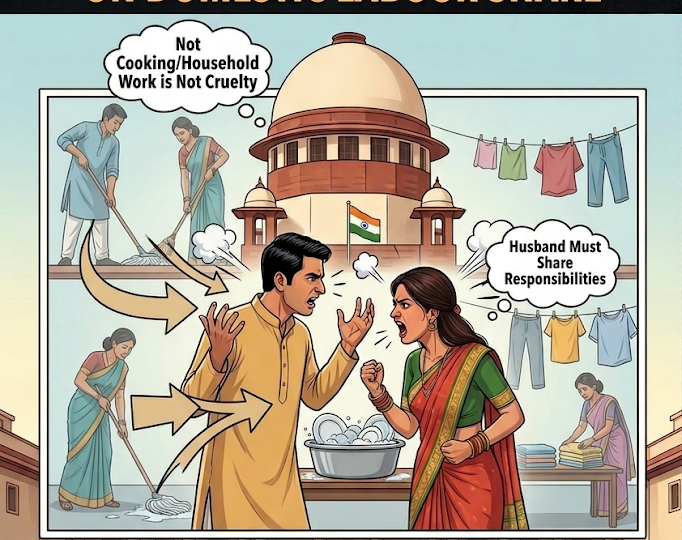
Supreme Court: Wife Not Doing Household Work Is Not Cruelty
The Supreme Court of India has clarified that a wife’s refusal to cook or perform household chores does not amount to cruelty under law. The Court emphasized that marriage is a partnership based on equality, not a relationship of servitude.
Background of the Case
The case arose from a marital dispute where the husband sought divorce on the ground of cruelty, alleging that his wife failed to perform household duties such as cooking and washing. He argued that her conduct caused mental harassment and justified dissolution of marriage.
The matter reached the Supreme Court after lower courts examined the allegations and legal grounds under matrimonial law.
Supreme Court’s Key Observations
Rejecting the husband’s claims, the Supreme Court made a strong statement on gender roles and expectations within marriage:
“The husband must remember that he has married a life partner and not a maid.”
The Court categorically held that a wife cannot be compelled to undertake domestic chores against her will, and refusal to do so cannot be treated as cruelty.
Further reinforcing the idea of shared responsibility, the Court observed:
“Household chores and domestic work are a shared responsibility between spouses.”
The Bench stressed that marriage is based on mutual respect, understanding, and companionship—not rigid gender roles or expectations.
Table of Contents
Cruelty Under Matrimonial Law
The Court clarified the legal threshold required to establish cruelty under matrimonial laws. It held that trivial issues or disagreements over household responsibilities do not meet the standard of cruelty required for divorce.
Importantly, the Court noted that:
“Mere refusal by the wife to do household work cannot be treated as cruelty.”
The judgment underscores that cruelty must be grave and serious in nature, not based on everyday marital disagreements or differences in lifestyle choices.
Changing Social Norms and Gender Equality
The ruling reflects evolving societal values and the need to recognize gender equality within marriage. The Court acknowledged that traditional expectations placing the burden of household work solely on women are outdated.
It emphasized that modern marriages require both partners to contribute equally, whether financially or domestically. The judgment sends a strong message against patriarchal notions that equate marriage with domestic servitude.

Legal Significance of the Judgment
This decision reinforces several important legal principles:
- Marriage is a partnership of equals, not a master-servant relationship
- Domestic work cannot be imposed solely on the wife
- Refusal to perform household chores does not constitute cruelty
- Courts must consider changing societal norms in matrimonial disputes
The ruling is expected to influence future cases involving allegations of cruelty based on domestic expectations.
Conclusion
The Supreme Court’s ruling marks a significant step toward gender justice in matrimonial law. By rejecting the notion that a wife is obligated to perform household chores, the Court has reinforced the idea that marriage is built on equality, dignity, and shared responsibility.
LATEST POSTS