
Supreme Court Upholds UGC Authority To Decide Consequences Of Annulled Illegal Degrees
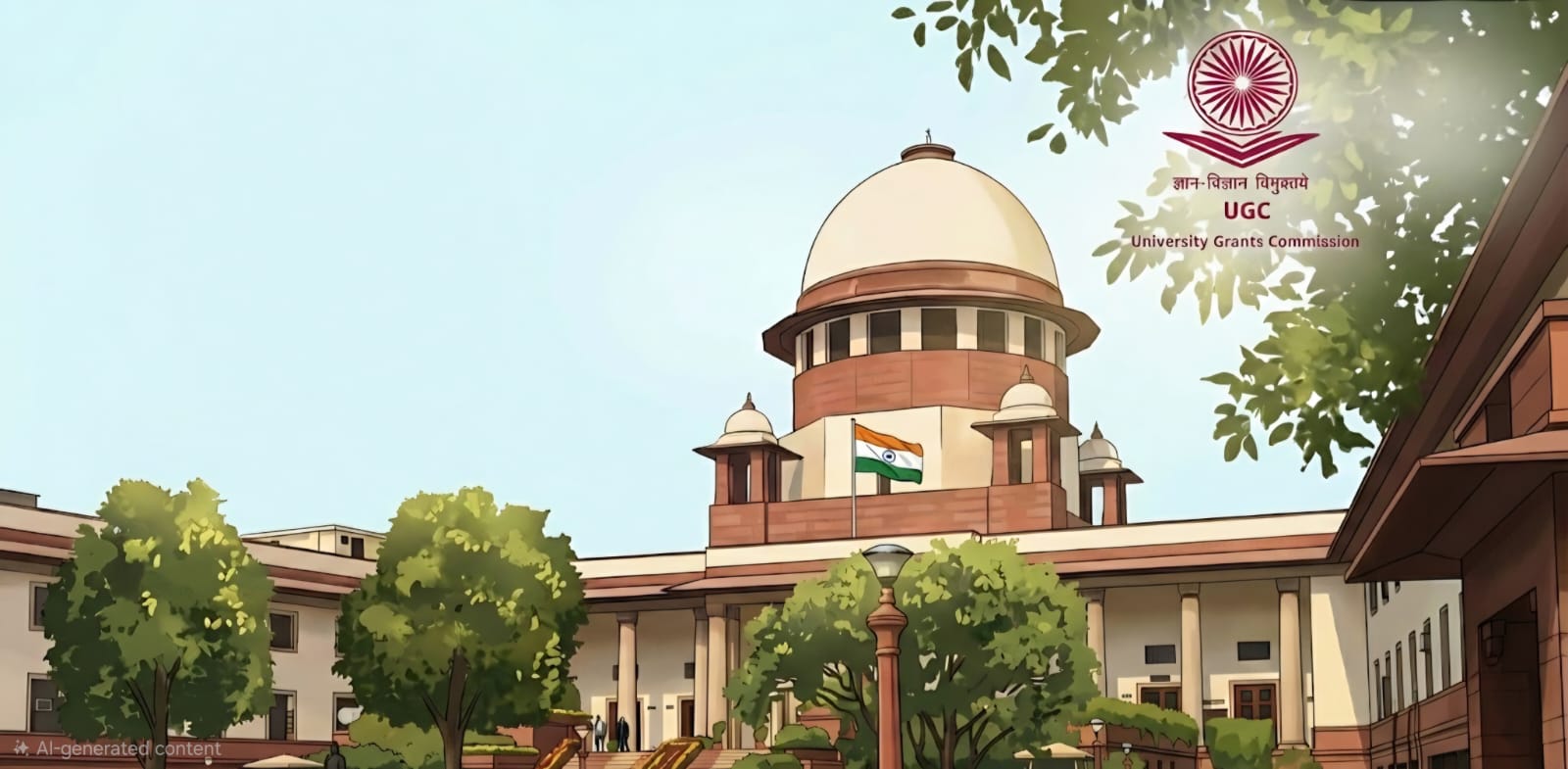
New Delhi: The Supreme Court of India has reaffirmed that the University Grants Commission (UGC) is the competent statutory authority to determine the consequences flowing from its own decisions annulling illegal academic degrees. The Court clarified that questions regarding whether affected students can retain any benefit from such annulled degrees must be decided by the UGC and not by constitutional courts exercising writ jurisdiction.
Table of Contents
The ruling came in an appeal filed by the UGC against a judgment of the Madras High Court, which had observed that students who pursued technical courses through distance education based on interim court orders “not be affected by the annulment of the courses if they had undergone the course on the basis of the interim orders of the Court.”
Modifying this view, the Supreme Court emphasized that the issue of consequences arising from annulment falls squarely within the statutory framework governing higher education regulation.
Bench and Case Details
The judgment was delivered by a Bench comprising Justice P.S. Narasimha and Justice Alok Aradhe on February 9, 2026, in THE UNIVERSITY GRANTS COMMISSION & ANR v. ANNAMALAI UNIVERSITY & ORS (SLP (C) Nos. 15406–15427/2023).
The dispute arose in relation to technical degrees granted through distance learning mode by Annamalai University. The UGC had previously taken the position that technical programmes cannot be offered via distance education without proper approval, and degrees issued contrary to regulatory norms were liable to be annulled.
The High Court had attempted to grant protection to certain students who had enrolled and completed courses relying on interim judicial orders. However, the Supreme Court held that determining whether such students are entitled to any equitable consideration is a matter of regulatory policy.
Reliance on Precedent
The Court referred to its earlier landmark decision in Orissa Lift Irrigation Corporation Limited v. Rabi Sankar Patro, where engineering degrees obtained through distance mode were invalidated on the ground that technical education cannot be imparted via distance learning in violation of statutory norms.
Further reinforcing its position, the Bench cited CMJ Foundation & Ors. vs. State of Meghalaya & Ors., wherein it was categorically held:
“UGC is the appropriate statutory authority to take decision, including to consider the consequences of its orders directing annulments of degrees that are illegal.”
This principle, the Court indicated, squarely governs the present controversy as well.
Directions Issued
To operationalize its ruling, the Supreme Court directed Annamalai University to furnish a complete list of students who had obtained the impugned technical degrees. Upon receiving the list, it will be for the UGC to examine the matter and determine the appropriate consequences in accordance with law and applicable precedents.
The Court thus set aside the portion of the High Court’s order that effectively insulated certain students from regulatory consequences, reiterating that courts cannot override the statutory mandate of the UGC in matters of academic regulation.
Implications for Higher Education
This decision has significant implications for India’s higher education regulatory framework:
- It reinforces the UGC’s exclusive authority over recognition and annulment of degrees.
- It clarifies that interim court orders do not automatically validate otherwise illegal academic programmes.
- It ensures that regulatory policy decisions remain within the domain of the statutory authority.
The ruling strengthens institutional accountability and underscores that academic standards and regulatory compliance cannot be diluted through judicial intervention where the statute assigns responsibility to a specialized authority.
With this judgment, the Supreme Court has drawn a clear boundary between judicial review and regulatory governance in higher education — reaffirming that consequences of illegal degrees must ultimately be determined by the UGC itself.
CASE TITLE: THE UNIVERSITY GRANTS COMMISSION & ANR V/S ANNAMALAI UNIVERSITY & ORS.
READ ORDER