
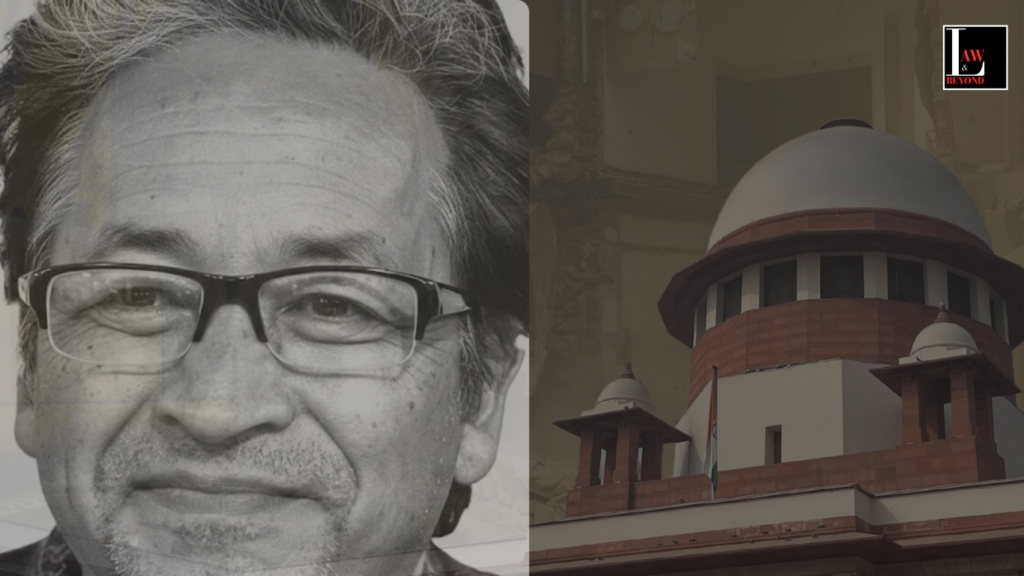
The Supreme Court of India is currently hearing a high-profile habeas corpus petition challenging the preventive detention of Sonam Wangchuk, a well-known climate activist, engineer and social reformer from Ladakh, under the stringent National Security Act (NSA), 1980. The case has drawn national attention as the Union Government and Ladakh administration made serious submissions before a Bench of Justices Aravind Kumar and P B Varale, alleging that Wangchuk’s speeches went beyond peaceful dissent and amounted to instigating a Gen-Z-style upheaval similar to protests witnessed in Nepal, Bangladesh and even the Arab Spring.
Table of Contents
Centre’s Accusations: Gen-Z Protest and “Arab Spring” Comparisons
At the Supreme Court hearing, Solicitor General Tushar Mehta, representing the Union Government, forcefully argued that Wangchuk’s public addresses were designed to mislead impressionable youth and instigate a “riot-like” movement. According to Mehta:
“Please mark this here. You … are anticipating or hoping for a riot-like situation in Nepal. It is a clear instigation otherwise, what is the relevance of Nepal and Ladakh? He is misleading the young generation to do what Nepalis did in their country… There is something very serious which my lords should see. What Mahatma Gandhi was doing was against another imperial government. Not instigating people to resort to violence against its own government. Comparison with Mahatma Gandhi is fallacious and only a facade to hide the completely inflammatory and instigatory speech.”
Mehta alleged that Wangchuk had not only referenced Arab Spring-style movements — where governments were toppled by mass protests — but had spoken of self-immolation as a form of protest, urging youth to emulate those events.
“Us vs Them” Rhetoric and Alleged Secessionist Tone
The Centre also accused Wangchuk of creating a divisive narrative by referring to the Central Government as “them” and the people of Ladakh as “us,” which the government labelled as secessionist in tone and threatening to the unity of the nation:
“He (Sonam Wangchuk) refers to the Central government as ‘them’. This ‘us’ and ‘them’ is enough for NSA detention. There is no ‘us and them’. We are all Indians,”
The Solicitor General submitted.
The government further claimed that his speeches included calls for plebiscite and referendum, similar to those previously made in Jammu and Kashmir, urging greater autonomy or a political decision by the people.
Details of Detention and Government Defence
Wangchuk was detained on September 26, 2025, by the Ladakh administration under the NSA in the aftermath of intense protests in Leh demanding statehood and inclusion in the Sixth Schedule of the Constitution. The unrest reportedly led to clashes with police and several casualties, after which the NSA order was issued to prevent further public disorder.
The government argued that the detaining authority examined speeches and other materials before issuing the order:
“It took four hours for the order of preventive detention to get executed as after the district magistrate passed the order, a DIG rank officer went to him and explained everything and showed him videos of his speeches. Grounds of detention was explained to him,”
Mehta told the Bench.
The Centre stressed that materials relied upon were relevant and did not constitute wrong or borrowed grounds, asserting that officials familiar with the speeches had presented the evidence.
Wangchuk’s Denial and Defence Before the Court
In contrast, Wangchuk has denied all allegations of inciting violence or overthrowing the government. During hearings, he emphasised his democratic right to criticise and protest:
Activist Sonam Wangchuk denied allegations of making a statement to overthrow the government like the ‘Arab Spring’, emphasising that he has the democratic right to criticise and protest.
His defence team, led by senior advocate Kapil Sibal, argued that some speeches were selectively clipped or misquoted, misrepresenting his actual statements. The defence highlighted that the activist has praised the government and the Prime Minister in other videos and contended that peaceful protest and criticism do not equate to threats to national security.
Legal and Constitutional Implications
The controversy raises profound questions about the limits of preventive detention laws, the balance between freedom of speech and national security, and how public order concerns should be weighed when dissent escalates into larger political movements. The Supreme Court’s ongoing examination will determine whether the NSA detention was justified or whether it represents an overreach that stifles legitimate dissent in a democratic society.
ALSO READ: “Parents Must Be Blamed”: Supreme Court Grants Bail in Pune Porsche Crash Case
RECENT POSTS: