
Supreme Court Rules Husband’s Duty to Maintain Ex-Wife After Divorce Cannot End Simply Because She Is Educated or Has Parental Support
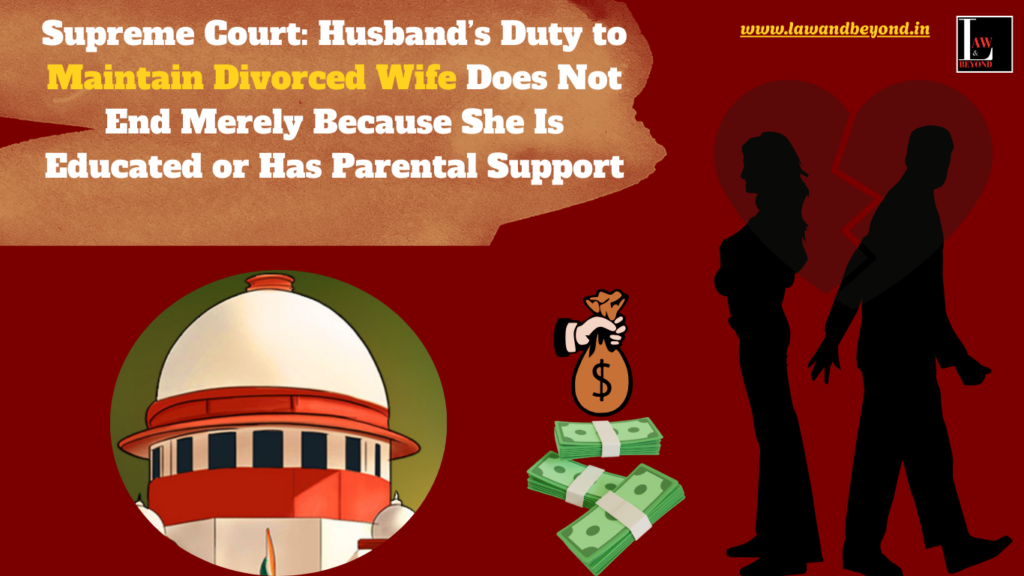
In a crucial judgment strengthening the rights of divorced women, the Supreme Court of India has ruled that a husband’s obligation to provide maintenance to his former wife does not automatically cease merely because she is educated, capable of employment, or has parental support. The ruling reiterates that maintenance laws are intended to ensure dignity and prevent destitution, rather than being decided on narrow technical grounds.
The decision was delivered by a bench comprising Justices SVN Bhatti and R. Mahadevan while hearing an appeal filed by a divorced woman challenging the adequacy of maintenance awarded to her by the family court. The family court had earlier fixed monthly maintenance at ₹15,000 despite the husband earning approximately ₹1.6 lakh per month.
The woman contended before the apex court that the awarded amount was insufficient to meet her basic needs and did not reflect the standard of living she was accustomed to during the marriage. She argued that rising inflation and the financial disparity between the parties had not been adequately considered.
The husband, however, opposed the enhancement of maintenance, claiming that the woman was well-educated, capable of earning on her own, and continued to receive support from her parents. He further submitted that he had suffered financial strain due to subsequent marital responsibilities.
Rejecting these arguments, the Supreme Court made it clear that education or parental support cannot be decisive grounds to deny or reduce maintenance. The bench observed:
“Marriage, as an institution in our society, is founded on emotional bonding, companionship, and mutual support, which cannot be evaluated in purely monetary terms.”
The Court further emphasised:
“The obligation of the husband to ensure that the wife is able to live with dignity does not come to an end merely on the ground that she is educated or has parental support.”
Placing reliance on established jurisprudence, the bench referred to Rajnesh v. Neha, wherein the Supreme Court had earlier clarified:
“It is no answer to a claim of maintenance that the wife is educated and could support herself.”
The Court reiterated that while education and employability may be relevant considerations, they cannot override the statutory and constitutional objective of ensuring social and economic justice. Maintenance must be assessed based on multiple factors, including the financial capacity of the husband, the needs of the wife, inflation, and the lifestyle enjoyed during the subsistence of marriage.
Taking these aspects into account, the Supreme Court enhanced the monthly maintenance from ₹15,000 to ₹30,000, holding that the earlier amount failed to meet the ends of justice.
The judgment also reinforces the broader legal principle that maintenance under Section 125 of the Code of Criminal Procedure is meant to provide immediate relief and prevent hardship to women who are unable to maintain themselves after separation or divorce. Courts have consistently held that such relief should ordinarily be granted from the date of application, as financial vulnerability arises the moment matrimonial support ceases.
At the same time, the Supreme Court clarified that maintenance is not meant to serve as a tool for wealth redistribution or indefinite financial dependency. Each case must be assessed on its own facts, balancing fairness to both parties.
Legal Significance
This ruling strengthens the protective framework around divorced women by reaffirming that dignity, not mere employability, is the cornerstone of maintenance law. It sends a clear message that courts will look beyond superficial indicators of independence and focus on real economic realities while adjudicating maintenance claims.
READ JUDGEMENT
READ THIS: “Supreme Court Slams WhatsApp & Meta Over Privacy Policy, Warns Against Exploitation of Users’ Right to Privacy”