

Supreme Court Clarifies Law on Anticipatory Bail for Absconding Accused
Supreme Court rules absconding accused cannot seek anticipatory bail merely due to co-accused acquittal. Key observations and legal principles explained.
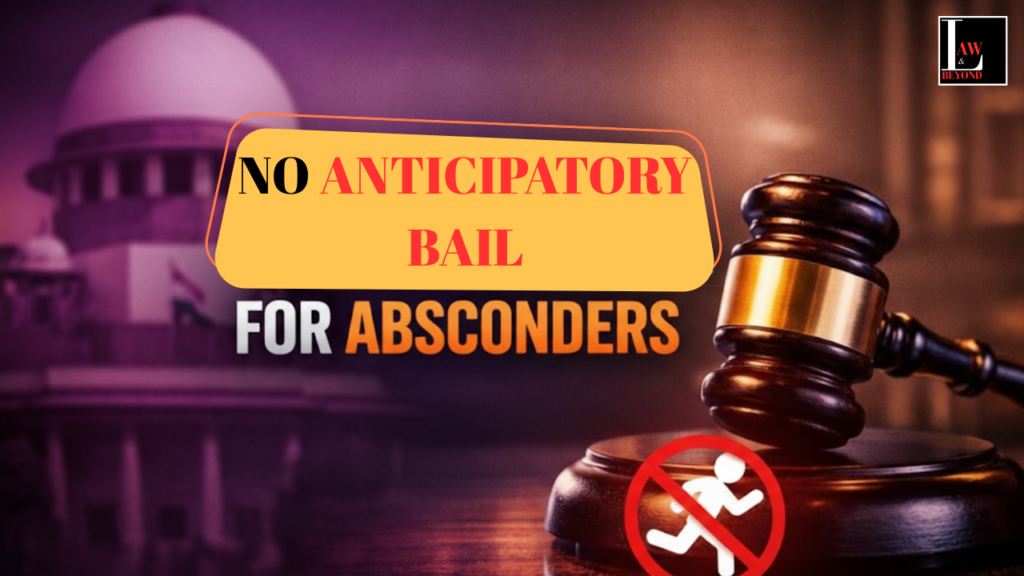
The Supreme Court of India has held that an absconding accused cannot seek anticipatory bail merely because co-accused persons were acquitted after trial.
The decision came in Balmukund Singh Gautam v. State of Madhya Pradesh, where the Court set aside the anticipatory bail granted by the Madhya Pradesh High Court.
The Bench comprising Justice J.B. Pardiwala and Justice Vijay Bishnoi delivered the judgment.
Table of Contents
Background: Six Years of Absconding
The case arose from multiple FIRs registered after a violent incident in Madhya Pradesh. While other co-accused participated in the trial and were acquitted, the present accused remained absconding for nearly six years.
After the acquittal of co-accused, he approached the High Court seeking anticipatory bail on the ground of parity. The High Court granted relief, observing lack of cogent evidence against him and relying on findings recorded during the trial of co-accused.
This order was challenged before the Supreme Court.
Supreme Court: Parity Cannot Be Claimed by Absconders
Allowing the appeal, the Supreme Court held:
“The ground raised by the absconding accused that other co-accused in the subject FIR have been acquitted by the trial Court does not ipso facto entitle him to the relief of anticipatory bail on the ground of parity, particularly when the accused himself failed to cooperate with the Court and delayed the trial of the other co-accused by absconding.”
The Court described the High Court’s reasoning as:
“Completely erroneous and perverse.”
The Bench further clarified that findings recorded in the trial of co-accused cannot automatically benefit an absconding accused. The prosecution is not required to lead evidence against someone who deliberately avoids the judicial process.
In a strong policy observation, the Court stated:
“Granting anticipatory bail to such an absconding accused would set a bad precedent and send a message that the law-abiding co-accused persons who stood trial were wrong to diligently attend the process of trial and further incentivises people to evade the process of law with impunity.”
Exception: When Can an Absconding Accused Still Seek Anticipatory Bail?
The Supreme Court clarified that although absconding conduct weighs heavily against the grant of anticipatory bail, it does not create an absolute bar in every case. The Court observed that in rare and exceptional circumstances, anticipatory bail may still be granted to an absconding accused if the FIR and the materials on record, taken at face value, fail to disclose any prima facie case against such an accused.
In other words, if the allegations are inherently improbable, manifestly mala fide, or do not satisfy the basic ingredients of the alleged offences, the court may exercise discretion in favour of the applicant despite prior absconding. However, the Bench made it clear that this is not a rule but a narrowly carved exception, and the burden lies heavily on the accused to demonstrate that the prosecution’s case is wholly untenable on the face of the record.
Key Legal Principles on Anticipatory Bail
The Supreme Court reaffirmed the following principles:
*Acquittal of Co-Accused Does Not Automatically Create Parity
Parity cannot be invoked when the accused has evaded the process of law.
*Absconding Conduct is a Relevant Consideration
Long absconding conduct weighs heavily against grant of anticipatory bail.
*Exceptional Cases May Differ
In rare cases, if the FIR and materials show no prima facie case, anticipatory bail may still be considered — but such grounds must be clearly established.
The Court also noted aggravating circumstances, including allegations of threats to a key eyewitness and participation in unlawful assembly.
Final Directions
Setting aside the High Court’s order, the Supreme Court directed the accused to surrender before the trial court and seek regular bail in accordance with law.
This judgment reinforces that anticipatory bail under Section 438 CrPC is discretionary, and absconding cannot become a strategic advantage in criminal proceedings.
CASE TITLE: BALMUKUND SINGH GAUTAM VERSUS STATE OF MADHYA PRADESH AND ANR.
READ JUDGEMENT
RECENT POSTS