
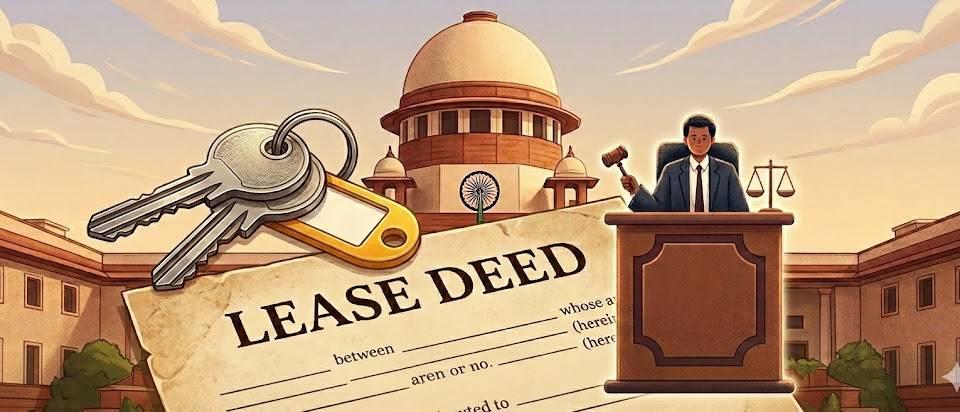
Clear Lease Deed Cannot Be Reinterpreted Based on Later Conduct | 99-Year Lease Upheld: Supreme Court

In a significant ruling on property law and interpretation of documents, the Supreme Court of India has held that when the terms of a deed are clear and unambiguous, courts cannot reinterpret the document on the basis of the parties’ later conduct. The judgment in The General Secretary, Vivekananda Kendra v. Pradeep Kumar Agarwalla and Others (2026 INSC 199) reaffirms the primacy of the plain meaning rule in construing lease deeds.
The decision was delivered by a Bench comprising Justice Pankaj Mithal and Justice S.V.N. Bhatti.
Background of the Dispute
The dispute arose from a registered deed dated 23 March 1998 executed by Late Anima Bose in favour of Vivekananda Kendra. Under the instrument, the Kendra was granted rights over the property for a period of 99 years at an annual rent of ₹1,000.
The deed repeatedly used expressions such as “demise,” “lease,” and “to hold for 99 years,” and also permitted succession by heirs and permitted assigns. Subsequently, in December 2003, the executant unilaterally cancelled the lease and issued a notice asking the Kendra to vacate the premises. The property was later sold to third parties during the pendency of litigation.
The Trial Court and the First Appellate Court ruled in favour of the Kendra, holding that the lease was valid and that the unilateral cancellation was illegal. However, the Orissa High Court reversed the concurrent findings, prompting an appeal before the Supreme Court.
Table of Contents
Supreme Court on Interpretation of Clear Documents
Allowing the appeal, the Supreme Court restored the findings of the Trial Court and the First Appellate Court. The Bench made it clear that when contractual language is explicit, courts must rely on the text itself.
The Court observed:
“…courts must exercise far greater restraint when inferring the parties’ intention from circumstances arising after the creation of the terms. For, the conduct may not be in tandem with either the literal expression or the purpose of the document.”
Emphasizing the rule of literal construction, the Bench further held:
“We note that interpreting intention through purposive construction or through ex-post facto circumstances is unnecessary when the intention is understood from the plain and ordinary meaning of the text.”
The Court clarified that interpretation through surrounding circumstances is permissible only when ambiguity exists. In the present case, the terms of the lease deed were clear and required no reinterpretation.
Lease vs Licence: Legal Position Reiterated
A central issue in the case was whether the instrument created a lease or merely a licence. Reiterating the settled law laid down in Associated Hotels of India Ltd. v. R.N. Kapoor (AIR 1959 SC 1262), the Court quoted:
“if the document creates an interest in the property, it is a lease; but, if it only permits another to make use of the property, of which the legal possession continues with the owner, it is a licence.”
The Supreme Court held that the deed created an interest in the property and vested exclusive possession in the Kendra for 99 years. The fact that the lessor retained occupation over a small portion did not convert the lease into a licence.
Importantly, the Court clarified:
“there is no doubt that the nomenclature alone of the document is not the decisive factor of the nature of a document; it is the text and the context that point to the obligations undertaken by the parties to a written document.”
Final Verdict
Setting aside the Orissa High Court judgment, the Supreme Court upheld the validity of the 99-year lease and restored the decrees passed by the Trial Court and the First Appellate Court. The civil appeal was allowed without any order as to costs.
Significance of the Judgment
This ruling strengthens the principle that clear and unambiguous lease deed terms must be given effect as written. It prevents judicial reinterpretation based on subsequent conduct and reinforces certainty in long-term property transactions.
The judgment is expected to have wide implications for disputes involving lease deeds, property documentation, and interpretation of contractual instruments across India.
CASE TITLE: THE GENERAL SECRETARY, VIVEKANANDA KENDRA VERSUS PRADEEP KUMAR AGARWALLA AND OTHERS
RECENT POSTS:-