


Madhya Pradesh High Court Blocks Husband’s Demand for Wife’s Virginity Test; Calls It an Invasion of Privacy and Irrelevant to Divorce
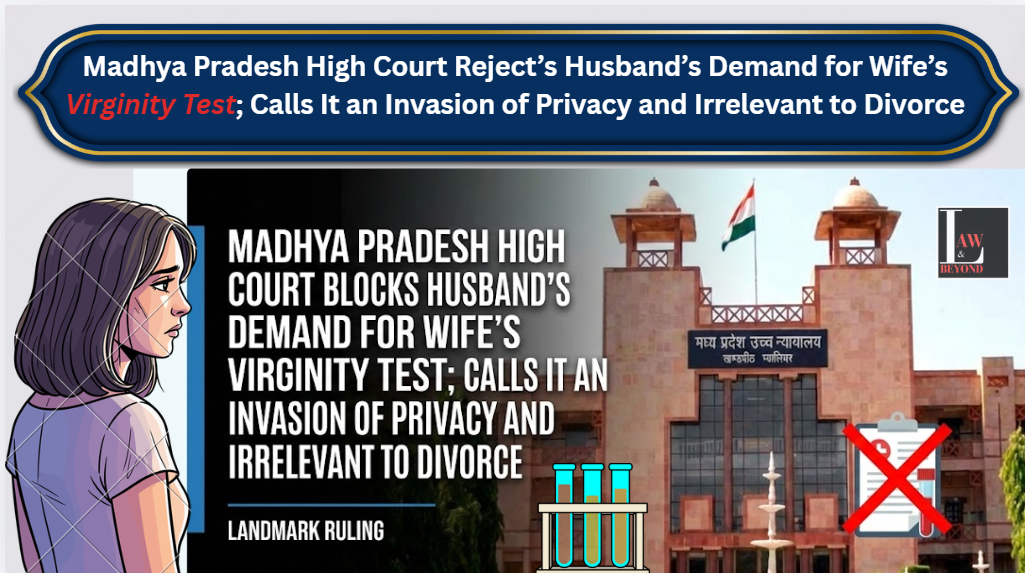
In a significant ruling dated January 21, 2026, the Madhya Pradesh High Court categorically rejected a husband’s plea seeking a medical examination of his wife to determine whether she had ever engaged in sexual relations. The Court held that such a request was nothing but a virginity test, which amounts to a serious invasion of privacy and has no relevance in divorce proceedings.
The case arose from a divorce petition filed by the husband on the ground of cruelty, wherein he alleged that his wife “had refused to enter into physical relationship with him.” The wife denied the allegations and, in turn, accused the husband of dowry harassment, physical and mental cruelty, and acts of sodomy, while also disputing claims regarding her mental health.
Table of Contents
Court’s Observations on Privacy and Divorce Law
Justice Vivek Jain, while dismissing the husband’s challenge to a family court order, observed:
“This Court does not find any substance in the plea made by the petitioner/husband to subject the respondent/wife to medical examination as the said examination would be nothing but a virginity test which would be an invasion of privacy of the individual and is not relevant for the purpose of divorce as refusal to enter into sexual intercourse in itself is not a ground of divorce.”
The Court clarified that refusal to engage in sexual relations does not automatically constitute cruelty under matrimonial law and cannot, by itself, be treated as a valid ground for divorce.
Hymen Status Cannot Prove Sexual History
The High Court also relied on well-settled medical principles to explain why such examinations are unreliable. It observed:
“The recent judicial trend is heavily against conducting a virginity test of a woman and even otherwise it is medically well settled that even after sexual intercourse hymen may remain intact in some rare cases, and on the other hand, hymen may be damaged even without sexual intercourse upon any other physical activity and, therefore, presence or absence of hymen, would not be a determinative factor to infer that whether there has been sexual intercourse with the respondent ever or not.”
The bench noted that attempting to draw conclusions about sexual history based on the condition of the hymen is scientifically flawed and legally impermissible.
Relevance Under the Hindu Marriage Act
The Court further held that such allegations do not render a marriage void or voidable under Sections 11 or 12 of the Hindu Marriage Act, 1955, nor do they fall within the grounds for divorce under Section 13 of the Act. It added that even allegations of sodomy, if made years later, cannot be conclusively proved through a medical examination and compelling such tests would amount to humiliation and violation of dignity.
Referring to medical guidelines and Supreme Court precedents, the High Court stated:
“Looking to the aforesaid medical guidelines issued by the Ministry of Health and Family Welfare… and ultimately the Hon’ble Supreme Court deprecated the practice of conducting two-finger test or virginity test…”
Alternative Evidence Allowed
While rejecting the request for a medical test, the Court clarified that the husband is free to rely on other legally admissible evidence to support his case. However, it categorically concluded:
“Virginity test or ‘two-finger test’ of the wife would neither be relevant nor be conclusive for the purposes of the divorce petition. It would be nothing but invasion of privacy.”
The judgment reinforces constitutional values of privacy, dignity, and bodily autonomy, and marks another step by Indian courts in dismantling outdated and discriminatory practices in matrimonial litigation.
READ JUDGEMENT
Connect with us
SHARE






One comment on “Madhya Pradesh High Court Rejects Husband’s Virginity Test Plea as Invasion of Privacy and Not a Divorce Ground”