

Kerala High Court Clarifies Who Can Use the ‘Dr’ Prefix
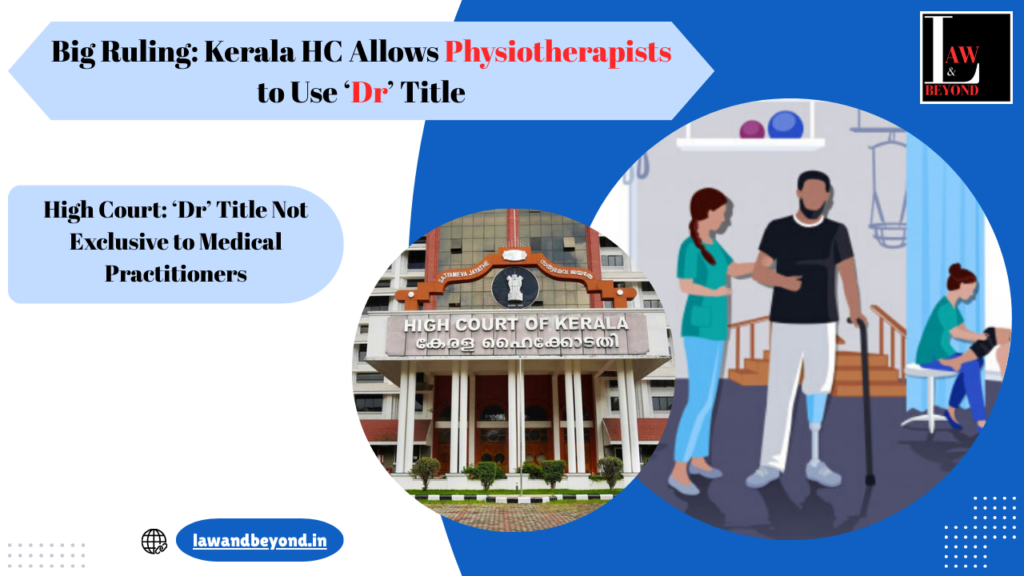
In a significant ruling interpreting professional titles within the healthcare sector, the Kerala High Court has clarified that the honorific prefix “Doctor (Dr)” is not the exclusive preserve of medical practitioners holding MBBS or equivalent degrees. The Court upheld the statutory framework under the National Commission for Allied and Healthcare Professions Act, 2021, permitting physiotherapists and occupational therapists to use the “Dr” prefix, subject to regulatory limitations. This judgment marks an important development in the legal recognition of allied health professions in India.
Table of Contents
Background of the Case
Multiple writ petitions were filed before the Kerala High Court by medical associations, including the Indian Medical Association and the Indian Association of Physical Medicine and Rehabilitation. The petitioners challenged the legality of allowing physiotherapists and occupational therapists to prefix “Dr” to their names, contending that such usage would mislead the public and dilute the statutory exclusivity of medical practitioners regulated under the National Medical Commission Act.
The challenge primarily targeted provisions of the National Commission for Allied and Healthcare Professions Act, 2021, along with competency-based curricula notified for physiotherapy and occupational therapy, which recognised these professionals as first-contact healthcare providers within defined limits.
Issues for Determination
The principal legal issue before the Court was whether the title “Doctor” or “Dr” is statutorily reserved exclusively for medical practitioners under Indian law, and whether allied health professionals could be restrained from using the said prefix.
Court’s Observations and Reasoning
The Division Bench, presided over by Justice V.G. Arun, rejected the argument that the prefix “Dr” belongs solely to medical practitioners. The Court undertook a historical and statutory analysis of the term “doctor” and observed that it is not confined to the medical profession alone.
The Court categorically held:
“Therefore, the contention that the title ‘doctor’ exclusively belongs to medical professionals is a misconception since even now, like in the olden times, persons with higher educational qualifications like PhD are entitled to use the title ‘doctor’.”
The Bench further clarified that neither the National Medical Commission Act nor any other statutory enactment expressly confers an exclusive right upon medical practitioners to use the title “Doctor”.
Addressing reliance placed on the Kerala State Medical Practitioners Act, the Court noted that references to “title” in the statute cannot be construed as granting monopoly rights over the “Dr” prefix.
Rejection of the “Reading Down” Argument
The petitioners had urged the Court to read down the provisions of the NCAHP Act and the allied health curricula, arguing that allied professionals should remain subordinate to medical practitioners. The Court declined to interfere with legislative policy, observing:
“…it will be inappropriate for this Court to tinker with the policy of the Government or read down the provisions of the Act or the Curriculum at the instance of a few medical professionals.”
The Court emphasised that allied health professionals are statutorily recognised to provide preventive, curative, rehabilitative, therapeutic, and promotional health services, subject to regulatory boundaries, including restrictions on prescribing allopathic medicines.
Regulatory Context and Interim Developments
The controversy intensified following the issuance of the Competency-Based Curriculum for Physiotherapy, which recommended the use of “Dr” with the suffix “PT”. An earlier interim order of the High Court had temporarily restrained such usage; however, the final judgment vacated that restraint, affirming the legality of the curriculum and statutory scheme.
The Court also took note of the withdrawal of a governmental communication that had earlier questioned the permissibility of the “Dr” prefix for non-medical professionals.
Conclusion and Legal Significance
This judgment reinforces the principle that professional titles must be interpreted within their statutory and historical context. By holding that the “Dr” prefix is not exclusively reserved for medical practitioners, the Kerala High Court has strengthened the legal recognition of allied healthcare professions while maintaining clear regulatory distinctions in medical practice.
The ruling is likely to have persuasive value in similar disputes across jurisdictions and contributes meaningfully to the evolving jurisprudence on professional identity and healthcare regulation in India.