
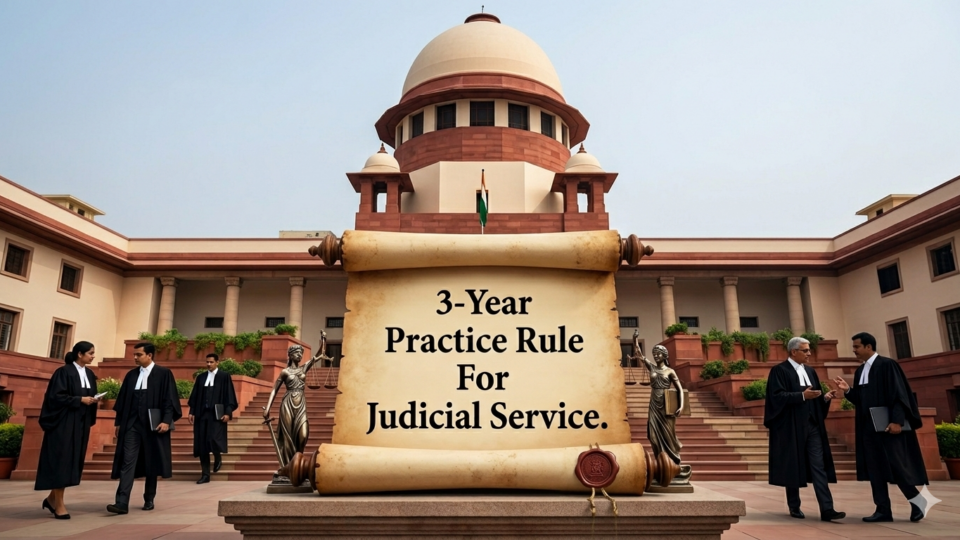
Supreme Court Questions 3-Year Practice Rule for Judicial Service; Raises Women Impact Concerns
New Delhi | February 26, 2026 — The Supreme Court of India has expressed serious reservations regarding the mandatory three-year legal practice requirement for candidates seeking entry-level positions in the judicial service. During the hearing of review petitions challenging the rule, the Court particularly highlighted its potential adverse impact on women aspirants and young legal talent.
A three-judge Bench comprising Chief Justice of India Surya Kant, Justice K. Vinod Chandran, and Justice A.G. Masih heard the matter in open court. Notably, the Court allowed the review petitions to be heard orally, deviating from the usual practice of deciding review matters in chambers through written submissions.
Table of Contents
Supreme Court’s Concern: Impact on Women and Young Talent
During the proceedings, the Chief Justice emphasized the increasing representation of women in the lower judiciary and cautioned against creating barriers that could discourage their participation.
The CJI observed:
“Most important issue is regarding young girls. Now almost 60% of judicial officers are girls, so that is very important to us. Because of this condition… No doubt practice is important, but we also have to see the impact on young talent. This creates a vacuum for 3 years.”
He further remarked:
“Girls are really shaken. Girls are the potential of our merit. Because of this condition, there is fear that they will never be able to complete because the family will not allow to complete.”
These remarks indicate that while courtroom exposure is valuable, the Court is concerned that the rule may unintentionally create systemic disadvantages for women candidates, particularly those facing societal and familial pressures.
Background: May 2025 Judgment Reinstating Practice Requirement
On May 20, 2025, the Supreme Court reinstated the requirement of a minimum of three years of practice as an advocate before applying for Civil Judge (Junior Division) posts. The decision was intended to ensure better practical exposure and competence among entry-level judicial officers.
Importantly, the Court clarified that the rule would operate prospectively, meaning it would not affect recruitment processes that had already commenced before the date of the judgment.
However, the ruling triggered widespread debate across the legal fraternity, with many arguing that structured judicial training programs and clinical legal education during law school already equip candidates with adequate foundational skills.
Constitutional and Equality Concerns Raised in Review Petitions
The review petitions, including those filed by Advocate Chandra Sen Yadav and Senior Advocate Colin Gonsalves, challenge the three-year practice rule on constitutional grounds. The petitioners argue that the rule may violate Article 14 (Equality before Law) and Article 16 (Equal Opportunity in Public Employment) of the Constitution of India.
They contend that the requirement disproportionately impacts:
- Women candidates
- Economically weaker aspirants
- Fresh law graduates
- Candidates from rural or disadvantaged backgrounds
Another key argument raised is the absence of empirical data demonstrating that judges appointed without three years of practice perform inadequately. Petitioners have also questioned the rationale behind fixing “three years” as the mandatory threshold.
High Courts Asked to Submit Feedback
During the hearing, the Supreme Court directed all High Courts to provide their responses regarding the implementation and impact of the three-year practice rule. The matter is expected to be listed again after receiving the feedback.
The outcome of this review could significantly reshape the eligibility framework for judicial service examinations across India.
Broader Implications for Judicial Recruitment
The debate over the three-year practice rule has become central to discussions on judicial reforms, gender representation, and accessibility in the legal profession. While ensuring practical courtroom experience remains important, the Court appears inclined to balance that objective against concerns of inclusion and equal opportunity.
Legal observers suggest that the Supreme Court may:
- Modify the duration requirement
- Introduce transitional provisions
- Or reconsider the mandate entirely
The final decision will have lasting implications for thousands of judicial service aspirants across the country.
RECENT POSTS