
Chhattisgarh High Court: Gift Deed Can Be Cancelled Without Maintenance Clause — Key Senior Citizens Act Ruling

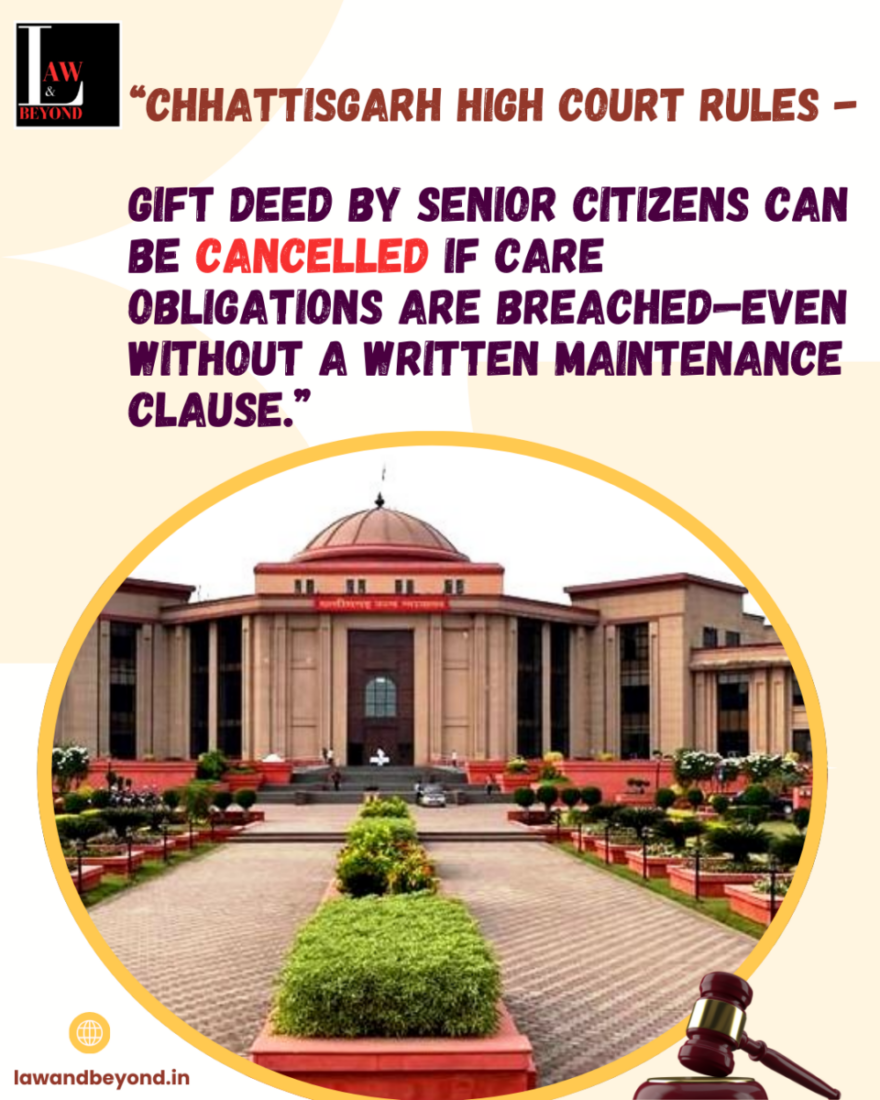
The High Court of Chhattisgarh at Bilaspur delivered a significant ruling reinforcing the protective framework of the Maintenance and Welfare of Parents and Senior Citizens Act, 2007 (“Act”). The Court held that a gift deed executed by senior citizens can be annulled under Section 23 of the Act even without an explicit maintenance clause, provided there is evidence of a breach of the transferee’s obligation to care for the donor.
Table of Contents
Background of the Dispute
In 2016, an octogenarian couple residing in Kanchan Vihar, Bilaspur, executed a gift deed in favor of their nephew, transferring ownership of a residential property. The transfer was allegedly motivated by “love and affection” and an assurance that the nephew would care for the elderly donors.
However, the couple later alleged that they were subjected to neglect and harassment, including denial of basic amenities such as food, water, and electricity, threats to life, and misuse of their ATM account with withdrawals amounting to ₹30 lakh. They were forced to relocate to an old-age home due to the deteriorating conditions at the gifted property.
Tribunal and Appellate Proceedings
The aggrieved senior citizens filed an application under Section 23 of the Act before the Maintenance Tribunal, seeking to cancel the gift deed on the grounds of neglect. The Tribunal declared the deed null and void, and this decision was upheld by the Appellate Authority.
The nephew challenged these orders before the High Court, arguing that the gift deed was voluntary and unconditional and did not contain a specific written obligation for maintenance. He further contended that only an expressly conditional deed could be revoked and relied on general principles under the Transfer of Property Act.
High Court’s Analysis and Ruling
Justice Narendra Kumar Vyas rejected the petitioner’s arguments, holding that the Act is a beneficial legislation designed to protect elderly individuals from neglect and abuse. Emphasizing the protective intent of Section 23, the Court observed that a maintenance condition need not be explicitly recorded in the gift deed if it can be inferred from the context, conduct of parties, and circumstances under which the gift was executed.
The Court referred to Section 23 of the Act, which provides that when a senior citizen transfers property “subject to the condition that the transferee shall provide basic amenities and physical needs to the transferor,” and the transferee fails to fulfill that obligation, the transfer shall be deemed to have been made by fraud, coercion, or undue influence and may be declared void at the transferor’s option.
In its ruling, the High Court stated:
“… the obligation to take such care would continue throughout the lifetime of the respondents … it needs not be expressed as written condition to declare the gift deed to be null and void … it is an implicit condition attached to this transfer of property by way of gift which was not fulfilled by the transferee…”
This reasoning aligns with judicial trends in other jurisdictions where courts have recognized that love and affection underlying family gift transactions inherently carry a duty of care and maintenance. For instance, several high courts, including the Madras and Telangana High Courts, have held that absence of an express maintenance clause does not absolve a donee from duty to maintain the donor under Section 23 of the Act.
Judicial Impact and Legal Implications
The Chhattisgarh High Court’s ruling reinforces the protective mandate of the Maintenance and Welfare of Parents and Senior Citizens Act. It clarifies that:
- A gift deed executed by senior citizens to family members can be cancelled if the transferee fails to provide basic care, even when the deed lacks an express maintenance clause.
- The condition of care and maintenance may be implied from circumstances, conduct, and relational context in which the gift was made.
- Courts and tribunals must interpret the Act in a way that prioritizes the dignity and welfare of senior citizens over strict technical formalities.
This interpretation aligns with broader judicial principles that aim to safeguard vulnerable senior citizens from exploitation following property transfers.
CASE TITLE: Ramkishna Pandey and Anr v. State Of Chhattisgarh and Ors
READ THIS: “Supreme Court Weighs Alternatives to Hanging in Death Penalty PIL U/S 354(5) CrPC”
READ JUDGEMENT