

Attempt to settle dispute cannot prevent police from taking cognizance
The Supreme Court acquitted four men in a 1998 gang rape case in Rajendra v State of Uttarakhand, holding that the prosecution failed to prove the charges beyond reasonable doubt.
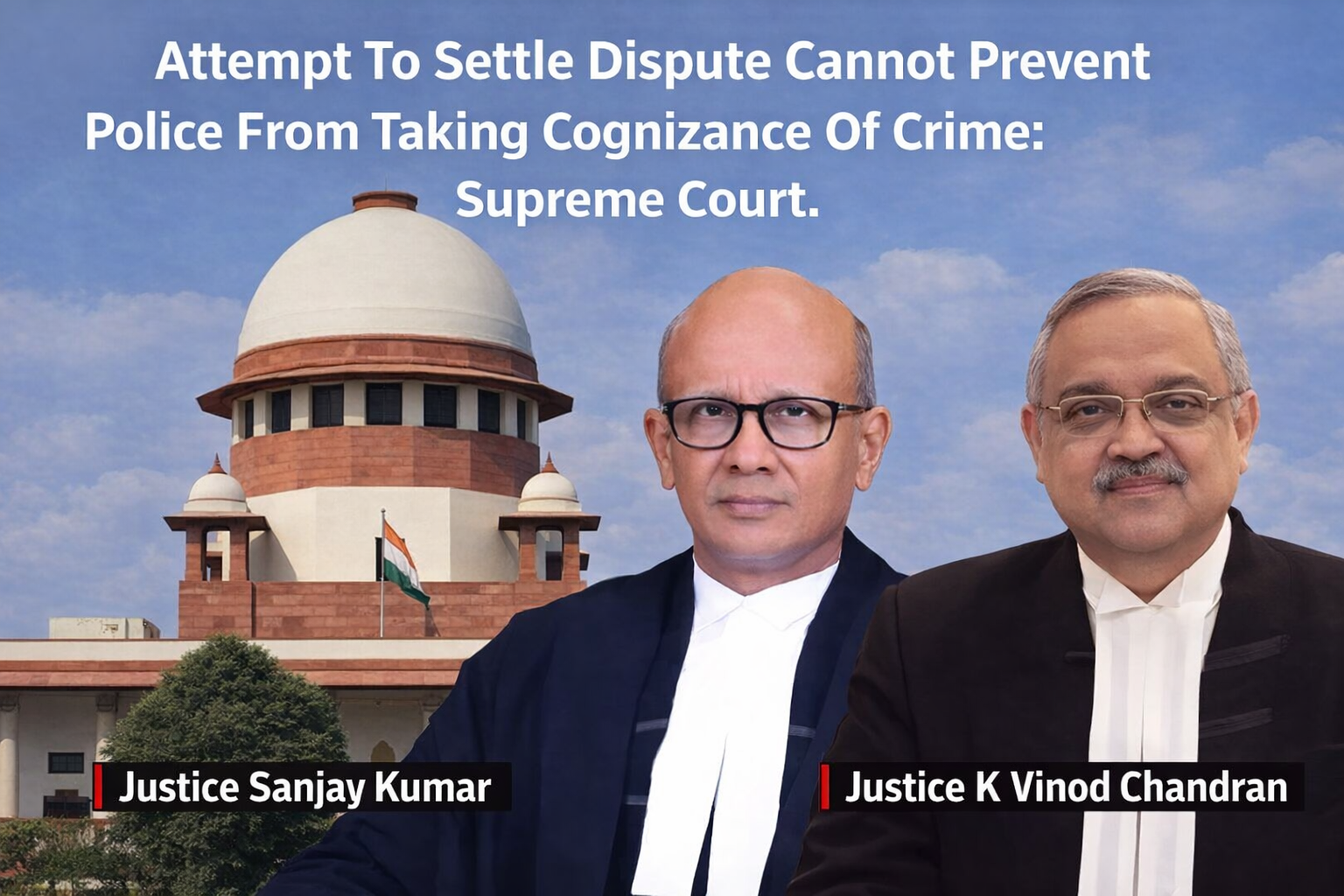
In an important ruling reaffirming the duty of law-enforcement authorities, the Supreme Court has observed that attempts to reconcile disputes between parties cannot prevent the police from taking cognizance of criminal acts when a cognizable offence is disclosed.
A Bench comprising Justice Sanjay Kumar and Justice K. Vinod Chandran made the observation while dealing with a matter arising out of a dispute between rival groups. The Court emphasized that even if the police attempt to bring about reconciliation between parties, such efforts cannot override their statutory obligation to act against criminal offences.
Reconciliation Efforts Cannot Override Criminal Law
The Supreme Court clarified that attempts to settle disputes amicably may sometimes be made by the police to maintain peace between the parties. However, such efforts cannot become a reason for failing to take legal action when criminal acts are alleged.
The Bench observed:
“The mere attempt at reconciliation cannot prevent the police from taking cognizance of criminal acts.”
The Court highlighted that reconciliation efforts are only conciliatory measures intended to prevent escalation of disputes. These attempts cannot replace the criminal justice process where the allegations disclose the commission of a criminal offence.
Table of Contents
Police Must Perform Their Statutory Duty
Reiterating the obligations of the police under criminal law, the Supreme Court stressed that law-enforcement authorities are required to act whenever a cognizable offence is revealed through a complaint or information received.
According to the Court, even if the police initially attempt to pacify the situation or encourage settlement between rival groups, they cannot ignore or overlook criminal conduct disclosed in the complaint.
The Court thus made it clear that reconciliation attempts do not legally prevent the police from registering a First Information Report (FIR) or initiating criminal proceedings.
Background Of The Case
The case before the Supreme Court arose from a conflict between two groups, during which the police had attempted to reconcile the dispute between them. The matter eventually raised the question of whether such reconciliation efforts could justify the failure to take cognizance of the alleged criminal acts.
Addressing this issue, the Court clarified that attempts to bring about peace between disputing parties cannot act as a legal barrier preventing the police from performing their duty under the law.
Supreme Court Reaffirms Rule Of Law
The ruling underscores a key principle of criminal jurisprudence—that criminal law operates independently of private negotiations or settlement attempts between parties.
While reconciliation efforts may help maintain public order, the Supreme Court stressed that they cannot override the legal duty of the police to act against criminal offences.
By reiterating that settlement attempts cannot prevent the police from taking cognizance of crimes, the Court reinforced the responsibility of law-enforcement authorities to ensure that allegations of criminal conduct are dealt with strictly in accordance with the law.
ALSO READ- “Supreme Court Upholds Conviction of Excise Inspector in 35-Year-Old Bribery Case, Reduces Sentence Considering Age”
LATEST POSTS