
Supreme Court: Surety Not Liable for Borrower’s Excess Withdrawals Beyond Loan Limit
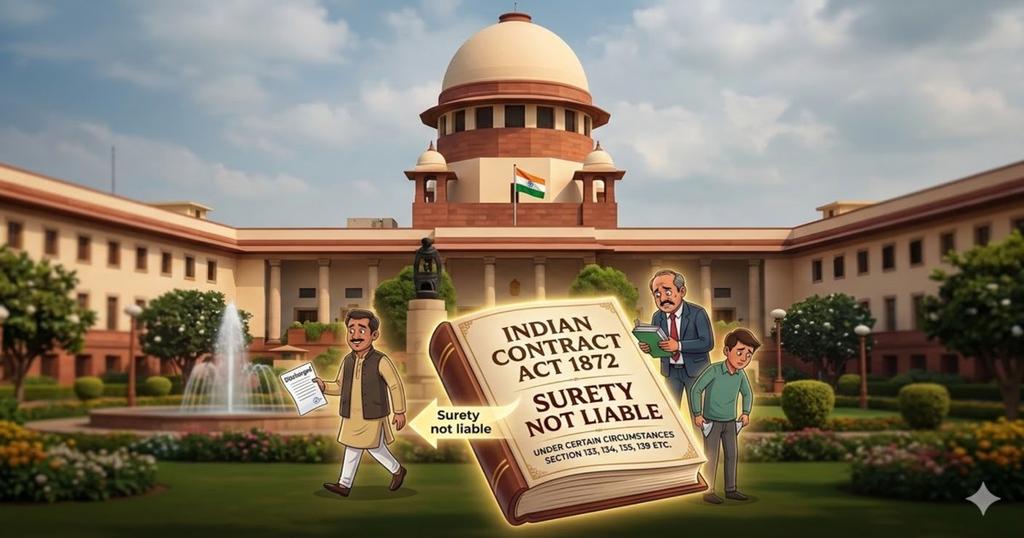
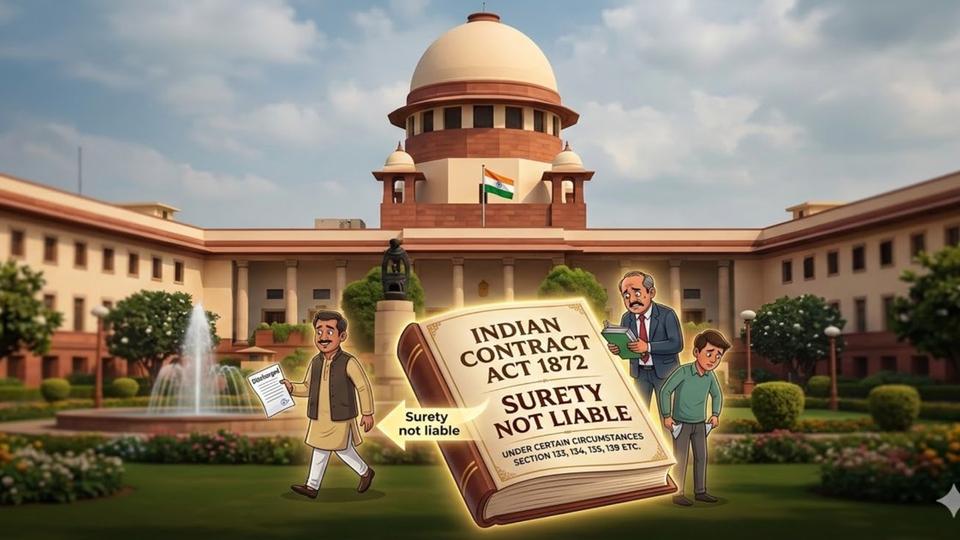
In an important ruling on the extent of a guarantor’s liability in loan transactions, the Supreme Court of India has held that a surety cannot be held responsible for amounts withdrawn by a borrower beyond the sanctioned credit limit if such withdrawals were allowed without the guarantor’s consent. However, the guarantor remains liable for the amount originally guaranteed under the loan agreement.
The decision came in the case of Bhagyalaxmi Co‑Operative Bank Ltd. v. Babaldas Amtharam Patel, where the Court clarified the legal position under the Indian Contract Act, 1872 regarding discharge of surety when contractual terms are varied without consent.
The judgment was delivered by a Bench comprising Justice B. V. Nagarathna and Justice Ujjal Bhuyan.
Background of the Dispute
The case arose from a loan transaction in which Bhagyalaxmi Co-Operative Bank Ltd. sanctioned a cash credit facility of ₹4,00,000 to a trading firm. The respondents had stood as guarantors for the loan.
However, the borrower later withdrew amounts far beyond the sanctioned credit limit. When the borrower defaulted, the bank initiated recovery proceedings claiming approximately ₹26.95 lakh along with interest from both the borrower and the guarantors.
During the proceedings, the Board of Nominees decreed the claim against the borrower but dismissed the claim against the surety. The Gujarat State Co-Operative Tribunal later held that the guarantors were liable only up to the sanctioned loan amount of ₹4,00,000 with interest.
However, the Gujarat High Court overturned this finding, observing that guarantors could either be liable for the entire amount payable by the borrower or not liable at all.
Table of Contents
Supreme Court’s Interpretation of Surety Liability
Allowing the appeal, the Supreme Court clarified that the High Court’s interpretation was inconsistent with the provisions of the Contract Act.
The Court observed:
“The surety is discharged only in respect of transactions that occurred subsequent to the variance of the terms of the contract.”
The Bench further held that the High Court’s view that guarantor liability could not be divided was legally incorrect.
The Court stated:
“The High Court was not right in holding that guarantors may be either liable to pay the entire amount which is deemed payable by the principal borrower or not at all and that there cannot be a bifurcation of the liability.”
The Court emphasized that the law permits partial discharge of a surety when the creditor alters the terms of the contract without the guarantor’s consent.
Explaining the statutory position, the Bench noted:
“This is contrary to Section 133 of the Act which speaks about discharge of surety by variance in terms of contract and that any variance made without the consent of the surety only can be resisted.”
Section 139 of the Contract Act Not Applicable
The guarantors had also invoked Section 139 of the Indian Contract Act, arguing that the bank’s conduct impaired their remedy against the borrower.
However, the Supreme Court rejected this argument and clarified the scope of the provision.
The Court held:
“In order to attract Section 139 of the Act, there must not only be an act inconsistent with the rights of the surety, or the omission to do an act which it is the creditor’s or employer’s duty to do, but it is essential that thereby the eventual remedy of the surety is impaired.”
Since there was no evidence showing that the guarantors’ ability to recover from the borrower had been impaired, the Court ruled that Section 139 could not be invoked in the present case.
Final Outcome of the Case
Setting aside the Gujarat High Court’s judgment, the Supreme Court restored the order of the Tribunal. The Court held that the guarantors were liable only up to the originally sanctioned loan amount of ₹4,00,000 along with applicable interest.
They could not be held responsible for the excess withdrawals made by the borrower beyond the sanctioned credit limit without their consent.
The ruling clarifies that guarantor liability under Indian contract law is not an “all-or-nothing” concept and that courts can determine liability proportionately when contractual terms are varied without the consent of the surety.
The judgment is expected to have important implications for banking disputes and guarantee agreements, particularly in cases involving unauthorized credit expansions or excess withdrawals by borrowers.
LATEST POSTS