
Supreme Court Condemns WhatsApp & Meta’s 2021 Privacy Policy, Issues Stern Warning on Right to Privacy
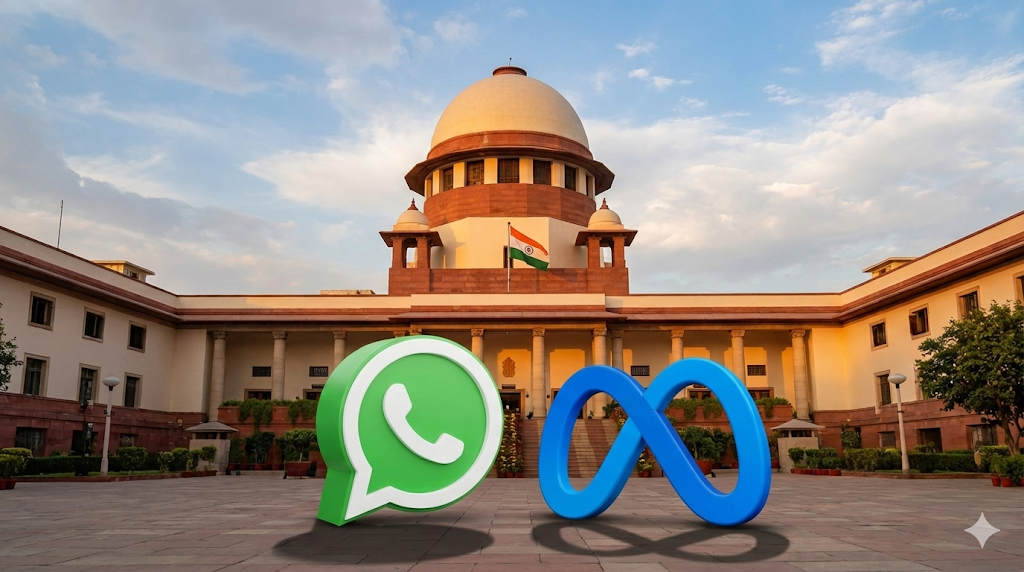
New Delhi, India — In a landmark hearing on February 3, 2026, the Supreme Court of India delivered sharp criticism against WhatsApp LLC and its parent company Meta Platforms Inc. over the messaging giant’s controversial 2021 privacy policy, terming the approach coercive and a threat to citizens’ fundamental right to privacy. The Court’s observations underscore growing judicial concern over digital consent frameworks and commercial exploitation of personal data.
A three-judge bench led by Chief Justice Surya Kant, along with Justices Joymalya Bagchi and Vipul Pancholi, was hearing appeals filed by WhatsApp and Meta against a ₹213.14 crore penalty imposed by the Competition Commission of India (CCI). The fine stemmed from WhatsApp’s “take-it-or-leave-it” privacy policy update, which mandated expanded data sharing with Meta’s corporate group without a clear opt-out mechanism.
Table of Contents
“You Can’t Play With the Right of Privacy…”
The apex court did not mince words in expressing its disapproval of WhatsApp’s consent model. CJI Surya Kant asked pointedly,
“Where is the question of opt out? Show me in your mobile. This is a decent way of committing theft of private information!”
The bench further emphasized that users should have a real choice when consenting to data sharing, warning that the current framework leaves little room for genuine user autonomy.
The Chief Justice also remarked during the hearing,
“You can’t play with the right of privacy of this country, in the name of data sharing. You are making a mockery of the constitutionalism of this country.”
The court observed that ordinary citizens, including those in rural areas, would struggle to understand the complexities of WhatsApp’s terms.
“A person sitting in rural Tamil Nadu, who only understands their language, how will they understand your terms?”
CJI Kant questioned counsel for WhatsApp.
Monopoly Power and Misleading Consent
The Bench also questioned WhatsApp’s claims of user choice, given its dominant position in India’s instant messaging market.
“What is the choice? You have complete monopoly in the market and you are saying I am giving a choice,”
the CJI pointedly said, countering the company’s defense that users had the option to opt out. When the company’s counsel insisted that the opt-out option existed, the court asked whether that option effectively meant withdrawing from the country.
Interim Directions and Government Involvement
Ahead of further arguments, the Supreme Court adjourned the case to February 9, 2026, and impleaded the Union of India as an additional respondent to explore interim directions. Solicitor General Tushar Mehta, arguing for the government, described the privacy policy as “exploitative” and raised concerns about how user data is monetized.
“Our personal data is not only sold, it is also commercially exploited … The data which is available in my personal life has a monetary value,”
he said.
The court also indicated that, in the interim, it might restrict WhatsApp and Meta from processing any user data pending final hearing, emphasizing that
“we will not allow you to share even a single piece of information.”
Broader Legal and Regulatory Context
This case follows a long-standing dispute that dates back to the CCI’s November 2024 ruling, which found WhatsApp’s privacy policy to be an abuse of dominance under Sections 4 and 19 of the Competition Act, 2002, as it forced users to consent to data sharing with Meta’s entities as a condition for continued service. While NCLAT later allowed partial relief to WhatsApp on certain aspects, it upheld the penalty — triggering the Supreme Court appeal.
The Supreme Court’s stern remarks are deeply rooted in India’s constitutional recognition of privacy as a fundamental right — a principle reaffirmed in Puttaswamy v. Union of India (2017), which held privacy as implicit under Articles 14, 19 and 21 of the Constitution.
Important Judicial Remarks from the Hearing
- “Where is the question of opt out? Show me in your mobile. This is a decent way of committing theft of private information!” — CJI Surya Kant.
- “You can’t play with the right of privacy of this country, in the name of data sharing. You are making a mockery of the constitutionalism of this country.” — CJI Surya Kant.
- “What is the choice? You have complete monopoly in the market and you are saying I am giving a choice.” — CJI Surya Kant.
- “We will not allow you to share even a single piece of information.” — Supreme Court (Interim directive suggestion).
- “Our personal data is not only sold, it is also commercially exploited … The data which is available in my personal life has a monetary value.” — Solicitor General Tushar Mehta.
What’s Next
The Supreme Court’s definitive judgment on this pivotal digital privacy dispute is eagerly awaited. The outcome could set significant precedent for consent standards, digital rights protections, and how global tech platforms operate in India’s legal and regulatory landscape.
CASE TITLE: Case Details: META PLATFORMS, INC Versus COMPETITION COMMISSION OF INDIA AND ORS.| C.A. No. 301-302/2026 & WHATSAPP LLC v CCI C.A. No. 366-367/2026
Also Read: “Parents Must Be Blamed”: Supreme Court Grants Bail in Pune Porsche Crash Case
RECENT POSTS
INSTAGRAM POSTS