

Supreme Court Rules Demolition of Private Property Must Be Supported by Clear Evidence; Extreme Measure for Blatant Illegalities
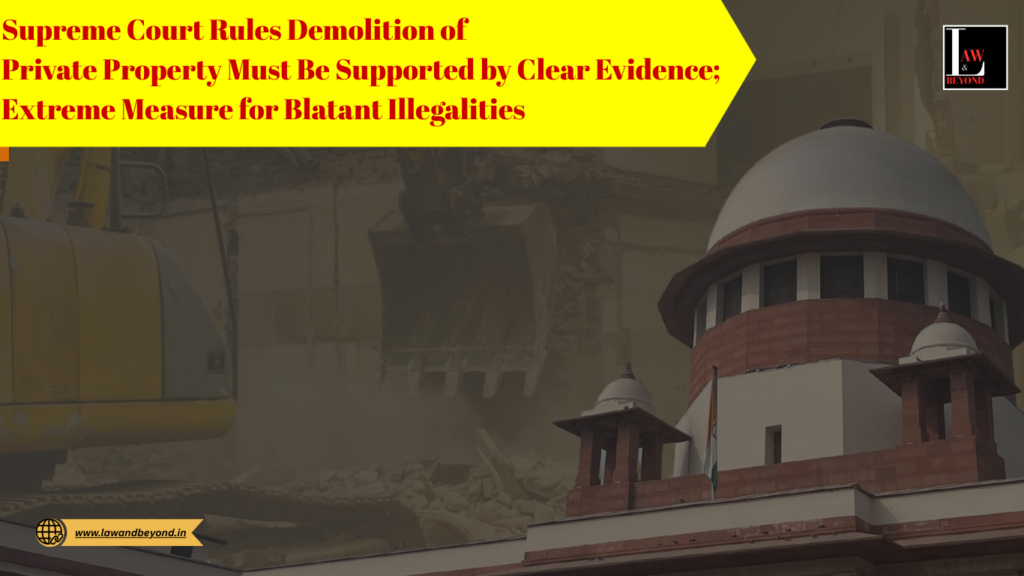
In a landmark ruling on January 29, 2026, the Supreme Court of India reinforced constitutional protections for private property by setting aside a demolition order of a multi-storey building issued by the Calcutta High Court. The apex court emphasised that demolition affecting private property under Article 300A of the Constitution “must be founded on clear, cogent, and site-specific evidence of illegality” and observed that demolition is “an extreme measure, reserved for blatant illegalities.”
Table of Contents
Property Rights & Article 300A — Strong Constitutional Safeguards
Article 300A guarantees that no person shall be deprived of their property save by the authority of law. The Supreme Court clarified that any interference with ownership — including demolition or loss of beneficial use — must rest on a clear statutory foundation and be preceded by a thorough consideration of factual and legal circumstances.
The Court criticised the Calcutta High Court’s demolition direction against Aarsuday Projects & Infrastructure Projects (P) Ltd, noting there was “no clear, scientific or contemporaneous material” to confirm the plot was “khoai” land as alleged. The term “khoai,” referring to lateritic soil formations described by Rabindranath Tagore, was not a recognised category under West Bengal revenue laws, undermining the factual basis of the High Court’s decision.
Bench’s Observations: Due Process and Evidentiary Standards
A two-judge bench comprising Justices Vikram Nath and Sandeep Mehta underscored the necessity of strong evidence before disrupting property rights:
“In the absence of any tangible evidence of fraud, misrepresentation, or deliberate circumvention of statutory requirements, a procedural lapse, even if assumed to exist, for arguments sake, could not render the construction per se illegal, nor could it justify the issuance of a direction for demolition, which is an extremely draconian consequence reserved for cases of blatant and substantive illegalities and violation.”
The bench reiterated that public interest litigation cannot be permitted to become a vehicle for selective or targeted challenges, especially where contested factual issues cannot be resolved through affidavits.
Importantly, the Court noted that the project had obtained requisite approvals from the competent authorities, and any minor conversion irregularity — such as the timing or manner of land use change from “danga” (barren land) to “bastu” (residential) — could not automatically invalidate the entire construction when there was no statutory provision mandating demolition as the inevitable outcome.

Demolition: Extreme and Disproportionate Without Blatant Illegalities
The apex court’s order aligns with similar judicial thinking that demolition is an extreme and disproportionate action when illegality is not proven beyond reasonable doubt. The top court stressed that even where authorities may find procedural lapses, regulatory scrutiny or corrective measures are more appropriate than demolition, especially when land use and planning permissions are in force.
The verdict also touched upon competency to grant approvals, refuting contentions that the Gram Panchayat lacked authority to approve building plans. The Court held that the November 5, 2011 approval by the Ruppur Gram Panchayat was valid and cannot be faulted.
Implications for Future Litigation and Property Law
This judgment reaffirms the Supreme Court’s commitment to protecting fundamental property rights. It clarifies that demolition orders must be the last resort and only upheld where illegality is blatant, well-evidenced, and backed by statute — not on speculative or unverified claims. Legal experts assert that this ruling will significantly impact how courts assess property disputes and demolition orders in future cases.
Also Read: “Pillion Rider Not Liable for Contributory Negligence Without Evidence of Causation: Delhi High Court”
Recent Posts:

Instagram Posts