

Menstrual Health Is Not a Women-Only Issue: Supreme Court Links It to Article 21
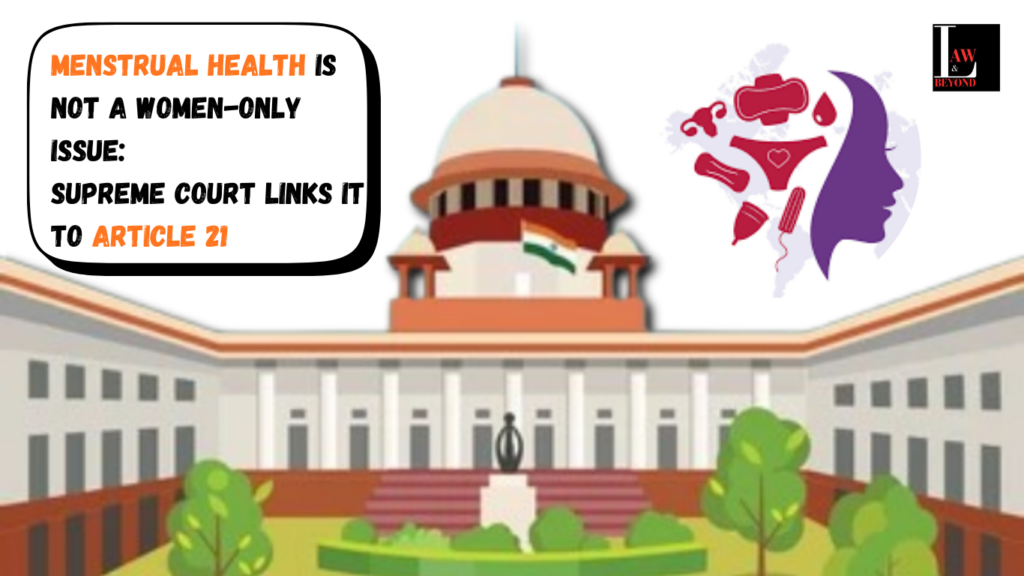
In a landmark ruling that reinforces constitutional dignity and equality, the Supreme Court of India has held that menstrual health and hygiene are integral to the right to life under Article 21 of the Constitution. The Court categorically ruled that menstruation cannot be treated as a women-only issue and must be discussed openly in schools with the involvement of boys and men to effectively eliminate stigma.
The judgment was delivered in Dr. Jaya Thakur v. Government of India & Ors., where the Court examined the structural and social barriers faced by adolescent girls due to inadequate menstrual hygiene facilities, lack of awareness, and societal taboos.
Table of Contents
Menstrual Health Linked to Right to Life and Dignity
The Supreme Court emphasised that menstrual hygiene is not merely a matter of convenience or welfare but a constitutional requirement flowing from Article 21. Denial of access to proper facilities and awareness was found to adversely impact dignity, autonomy, health, and educational participation of girls.
The Court observed that social stigma surrounding menstruation often results in humiliation, exclusion, and avoidable suffering, thereby violating the constitutional guarantee of a dignified life.
Underscoring the need for a shift in approach, the Bench stated:
“Time is over ripe that we recognize menstrual health as a shared responsibility rather than a woman’s issue.”
This observation marked a decisive move away from the traditional perception of menstruation as a private or gender-exclusive concern.
Men and Boys Must Be Part of Menstrual Awareness
A central feature of the judgment was the Court’s emphasis on the active role of men and boys in menstrual hygiene awareness, especially in school settings. The Court noted that schools are shared social spaces, and exclusion of boys from menstrual education perpetuates ignorance and stigma.
Clarifying this, the Court stated:
“All that we are trying to convey is that, men have a multifaceted role in menstrual hygiene and awareness for school-going adolescent girls. On one hand, male teachers can integrate accurate, stigma-free information into lessons… On the other hand, peers and classmates would be empathetic and helpful.”
The Bench further warned that infrastructure alone is insufficient without a supportive environment, observing:
“A school may have adequate facilities for menstrual hygiene, but an unsupportive, rather hostile and stigmatized environment would render them of no use. The environment at school is not a monolith of females, it consists of young boys, male teachers, and male staff.”
Nationwide Directions for Schools and States
To ensure effective implementation, the Supreme Court issued binding directions to all States and Union Territories. These include ensuring that every school has functional, gender-segregated toilets with water supply, privacy, and hand-washing facilities.
The Court also directed that free biodegradable sanitary napkins be made available to school-going girls, particularly those studying in Classes 6 to 12. Schools were further instructed to establish Menstrual Hygiene Management (MHM) corners equipped with emergency supplies such as spare uniforms, innerwear, and safe disposal mechanisms.
The Court noted that these measures are critical to addressing menstrual poverty, which often leads to absenteeism and school dropouts among adolescent girls.
Impact on Right to Education and Gender Equality
The judgment linked menstrual health directly with the right to education, holding that lack of hygiene facilities and awareness creates structural barriers that disproportionately affect girls. By mandating inclusive awareness involving boys, teachers, and staff, the Court sought to ensure that schools become safe, dignified, and inclusive spaces.
Conclusion
This ruling marks a significant advancement in constitutional jurisprudence by recognising menstrual health as a shared societal responsibility and a fundamental right. By calling for openness, institutional reform, and collective participation, the Supreme Court has laid the foundation for dismantling long-standing menstrual taboos and ensuring dignity, equality, and educational access for girls across India.
READ JUDGEMENT
READ THIS: “Supreme Court Stays UGC Equity Regulations 2026; Flags Vagueness, Exclusion and Risk of Social Division”
INSTAGRAM POSTS