

Big Legal Clarification: Kerala HC Says Angry Words Alone Don’t Prove Abetment of Suicide
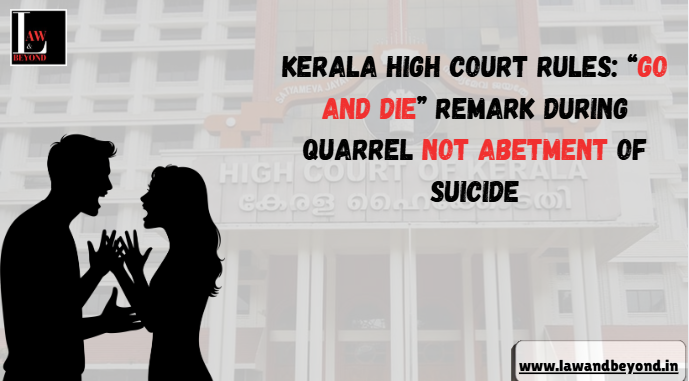
In a significant legal development, the Kerala High Court has held that uttering the words “go away and die” during a domestic quarrel does not automatically constitute the offence of abetment of suicide under Section 306 of the Indian Penal Code (IPC). The High Court’s decision, delivered on 28 January 2026 by Justice C. Pratheep Kumar, clarified that intention (mens rea) is the key ingredient to prove abetment of suicide, rather than the deceased’s emotional reaction to heated words spoken in a moment of passion.
Background of the Case
The case arose from a tragic incident wherein a woman, allegedly in an extramarital relationship with the petitioner (accused), died by suicide along with her five-and-a-half-year-old daughter on 15 September 2023, after purportedly being told by the petitioner to “go away and die” during an argument. The incident was registered as Crime No. 577/2023 at Melparamba Police Station, Kasaragod, and subsequently framed as S.C. No. 427 of 2024 before the Additional Sessions Court-I, Kasaragod. The sessions court initially refused to discharge the accused from charges under Sections 306 (abetment of suicide) and 204 (destruction of evidence), IPC.
The accused filed a Criminal Revision Petition (Crl. Rev. Pet. No. 1224 of 2025) under Sections 438 and 442 of the Bharatiya Nagarik Suraksha Sanhita (BNSS) challenging the sessions court’s decision and seeking discharge from the charges.
Table of Contents
Legal Analysis by the High Court
In its detailed analysis, the High Court emphasized that abetment under Section 306 IPC cannot be established merely on the basis of words spoken in the heat of a quarrel without clear evidence of intent to instigate the deceased into committing suicide.
Referencing the statutory definition under Section 107 of the IPC, the Court reiterated:
“Instigation denotes incitement, urging forward, provocative or encouraging another person to do an act. Presence of mens rea, therefore, is the necessary concomitant of instigation.”
The Court also relied on Supreme Court precedents, including Sanju Alias Sanjay Singh Sengar v. State of M.P. (2002), to delineate that:
“Even if we accept the prosecution story that the appellant did tell the deceased ‘to go and die’, that itself does not constitute the ingredient of ‘instigation’.”
Further drawing from earlier decisions such as Swamy Prahaladdas v. State of M.P. (1995), the Court emphasized that casual or angry words used in the spur of the moment between quarreling parties do not satisfy the legal requirements of abetment.
Importantly, the judgment noted:
“What is important is the intention of the accused and not what is felt by the deceased.”
Given the absence of any credible evidence demonstrating that the accused’s remark was intended to incite the deceased to commit suicide, the Court concluded that the essential elements of Section 306 IPC were not made out.
Decision and Legal Implications
As a result, the Kerala High Court allowed the Criminal Revision Petition, set aside the sessions court’s order framing charges, and discharged the accused from the offences under Sections 306 and 204 of the IPC. This decision underscores that ordinary quarrels — even those with emotionally charged remarks — do not per se constitute criminal abetment unless accompanied by clear intention to provoke suicide.
This ruling brings important legal clarity for courts adjudicating cases involving alleged abetment to suicide, particularly in domestic and relationship contexts, reaffirming that intent remains the cornerstone of criminal liability in such offences under Indian law.
READ JUDGEMENT