

Allahabad High Court Maintenance Judgment: Wife’s Claim Denied
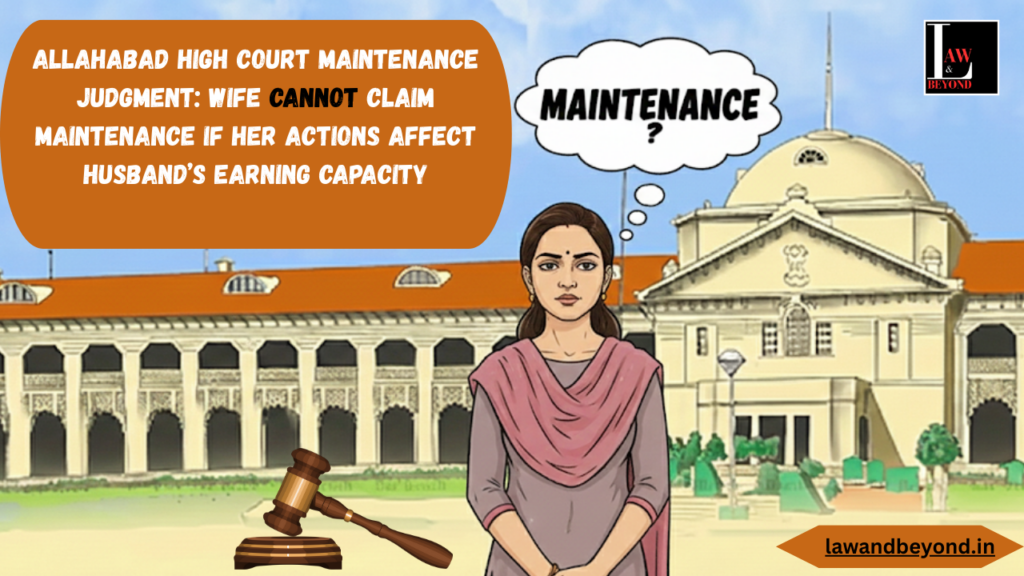
The Allahabad High Court maintenance judgment has provided important clarity on the interpretation of maintenance law under Section 125 of the Criminal Procedure Code (CrPC). The Court ruled that a wife cannot claim maintenance if her own actions or omissions contribute to her husband’s incapacity to earn. The decision reinforces that maintenance is a welfare measure rooted in equity and fairness, not an automatic entitlement.
Table of Contents
Background of the Case
The matter arose from a revision petition filed by a wife challenging an order passed by the Family Court at Kushinagar, which had rejected her application for interim maintenance. The husband, a homoeopathic doctor, suffered serious physical disability following a violent incident at his clinic.
According to the case record, the husband was allegedly shot during an altercation involving the wife’s father and brother. A pellet remains lodged in his spinal cord, and doctors warned that surgical removal could result in paralysis. Due to his medical condition, the husband was unable to sit comfortably or continue his medical practice, leading to a complete loss of earning capacity.
Observations of the Allahabad High Court
A Single Bench of Justice Lakshmi Kant Shukla upheld the Family Court’s order and rejected the wife’s claim for maintenance. The Court held that no person can be permitted to benefit from circumstances created by their own conduct.
The judgment stated:
“If a wife by her own acts or omissions causes or contributes to the incapacity of her husband to earn, she cannot be permitted to take advantage of such a situation and claim maintenance.”
The Court further observed:
“Granting maintenance in such circumstances would result in grave injustice to the husband, and the court cannot shut its eyes from the reality emerging from the record.”
Scope of Section 125 CrPC
Section 125 CrPC is intended to prevent destitution and vagrancy. However, the Allahabad High Court maintenance judgment clarified that courts must apply this provision with caution and judicial discretion. Maintenance cannot be granted mechanically without examining the conduct of the parties and the surrounding facts.
Acknowledging societal expectations, the Court noted:
“While Indian society generally expects a husband to work and maintain his family, this case presented unique circumstances.”
No Automatic Right to Maintenance
The High Court further highlighted that Indian law does not impose a statutory obligation on a wife to maintain her husband in the same manner. Nevertheless, this does not justify imposing maintenance liability on a husband whose earning capacity has been destroyed due to actions attributable to the wife or her family.
The ruling strengthens the principle that maintenance law must operate on fairness and justice, preventing misuse of beneficial provisions.
Legal Significance of the Judgment
The Allahabad High Court maintenance judgment is likely to influence future cases involving claims under Section 125 CrPC. Courts may now scrutinise contributory conduct more closely before granting maintenance. Legal experts believe the ruling ensures a balanced application of matrimonial law.
Conclusion
By dismissing the wife’s revision petition, the Allahabad High Court reaffirmed that maintenance is not an unconditional right. The judgment underscores that equity, justice, and factual realities must guide decisions in matrimonial disputes involving financial support.
ALSO READ: “Kerala High Court on the Use of the “Dr” Prefix by Allied Health Professionals”