
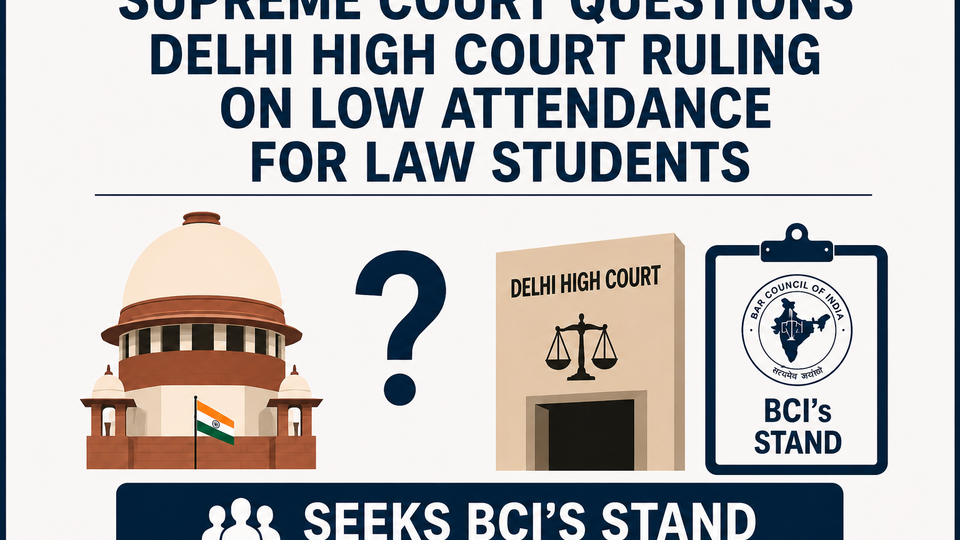
Supreme Court Questions Delhi HC Verdict Against Debarring Law Students Over Low Attendance
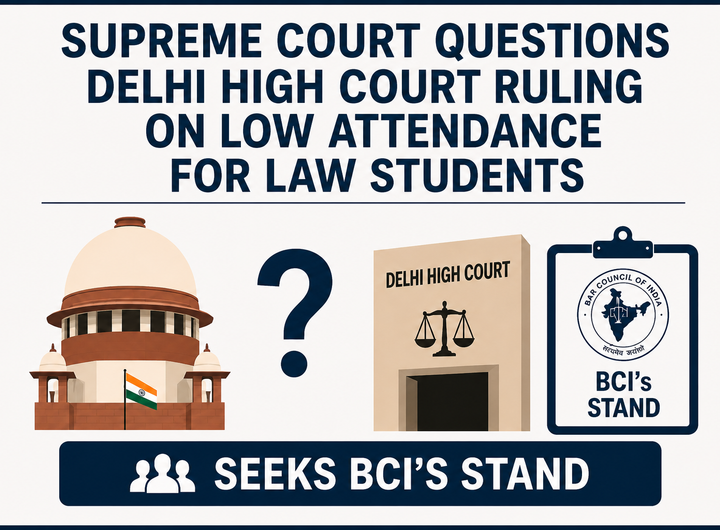
The Supreme Court of India, on May 7, 2026, expressed serious concerns over a recent Delhi High Court judgment, which held that a shortage of attendance should not prevent law students from continuing their academic pursuits or appearing in examinations. The top court observed that the ruling has created “chaos” for National Law Universities (NLUs) and questioned the implications of relaxing attendance requirements in legal education.
A Bench comprising Justice Vikram Nath and Justice Sandeep Mehta was hearing a Public Interest Litigation (PIL) filed by two final-year students of NALSAR University of Law challenging circulars issued by the Bar Council of India (BCI) in September 2024.
The impugned BCI circulars mandated criminal background verification, disclosure regarding simultaneous degree courses or employment, and compliance with attendance norms before enrolment into legal education or legal practice.
During the hearing, Justice Vikram Nath questioned BCI counsel Advocate Radhika Gautam on whether the Delhi High Court judgment had been challenged before the Supreme Court. Expressing concern over the consequences of the ruling, the Bench remarked:
“Students are not going to the classes…NLUs are known for their good faculty…if the students do not attend, what’s the point?”
The Supreme Court observed that the Delhi High Court ruling had become a “serious concern” for NLUs across the country. The Bench also noted that the issue of low attendance was connected to the controversy surrounding biometric attendance requirements raised in the present PIL.
As counsel for the BCI sought time to obtain instructions regarding the challenge to the Delhi High Court ruling, the matter was adjourned and re-listed for hearing next week. The Bench also reportedly indicated that even if the BCI does not challenge the judgment, the Supreme Court may still examine its correctness independently.
Background of the Delhi High Court Judgment
The controversy stems from a November 2025 judgment delivered by a Division Bench of the Delhi High Court in a suo motu case arising from the suicide of a law student in 2016. The case was initiated after the deceased student’s friend wrote a letter to the then Chief Justice of India alleging harassment by the college administration and faculty members over low attendance.
The Delhi High Court had ruled that:
“No student enrolled in any recognised law college, university or institution in India shall be detained from taking an examination or be prevented from further academic pursuits of career progression on the ground of lack of minimum attendance.”
The High Court further observed that attendance norms in legal education should not be so stringent that they result in mental trauma or contribute to student suicides. It directed the Bar Council of India to reevaluate mandatory attendance requirements for three-year and five-year LL.B. courses in line with the National Education Policy (NEP) 2020 and the 2003 University Grants Commission (UGC) Regulations, both of which contemplate flexibility in higher education.
Since the Division Bench ruling was neither stayed nor modified, a Single Judge Bench of the Delhi High Court in January 2026 relied upon it while deciding a batch of petitions filed by law students of the University of Delhi.
The petitioners, who had failed to meet the mandatory 70% attendance requirement, had been barred from appearing in semester examinations or had their results withheld. The Single Bench held that shortage of attendance could not be a valid ground to detain students or restrict their academic progression, treating the November 2025 Division Bench judgment as a binding precedent.
Table of Contents
Statutory and Regulatory Issues Involved
The case raises important questions concerning attendance regulations in legal education, the powers of the Bar Council of India to prescribe academic standards, and the balance between institutional discipline and student welfare.
The matter also touches upon implementation of the National Education Policy 2020, UGC Regulations of 2003, and BCI rules governing legal education and enrolment into the legal profession.
The case is titled: PRAKRUTHI JAIN v. BAR COUNCIL OF INDIA, Diary No. 47760/2024 (and connected matter).
ALSO READ: “Union Cabinet Approves Key Move to Increase Supreme Court Strength to 38 Judges”
LATEST POSTS:

FOLLOW US ON INSTAGRAM: