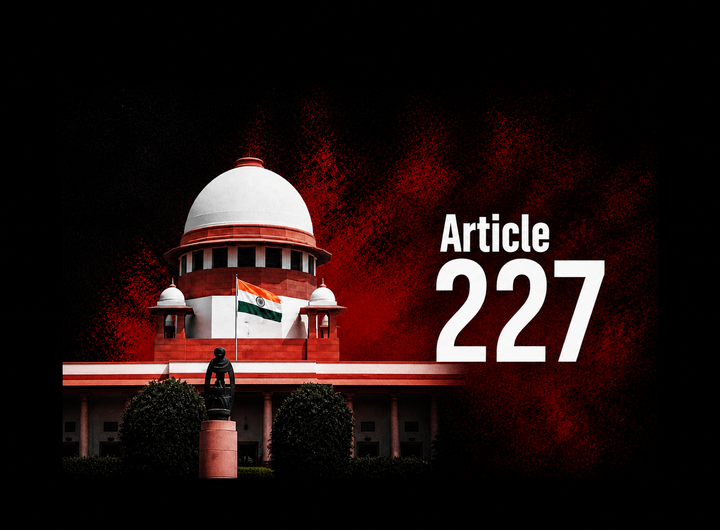

Supreme Court Limits Article 227 Powers: High Courts Cannot Substitute Execution Court Findings
The Supreme Court of India has reiterated that High Courts cannot act as appellate authorities while exercising powers under Article 227 of the Constitution. The judgment, delivered by a Bench comprising Justice Aravind Kumar and Justice N.V. Anjaria, emphasizes that plausible and reasonable findings of subordinate courts cannot be substituted merely because another interpretation is possible.
The ruling came in Nandi Infrastructure Corridor Enterprises Ltd. & Anr. v. B. Gurappa Naidu & Ors. (Neutral Citation: 2026 INSC 434; 2026 LiveLaw (SC) 445), wherein the Court set aside the High Court’s decision reducing compensation determined by the executing court.
Background of the Case
The dispute arose from a 2007 compromise decree between Nandi Infrastructure Corridor Enterprises (N.I.C.E.) and landowners in relation to the Bangalore-Mysore Infrastructure Corridor Project. As per the settlement, if N.I.C.E. failed to provide alternate land, it was required to compensate the landowners based on the “guideline value” fixed by the Government at the relevant time.
Upon failure to provide alternate land, the Decree Holders initiated execution proceedings. The executing court determined the compensation at ₹1,000 per sq. ft., relying on a 2007 Government notification applicable to converted urban land within municipal limits.
However, the High Court, in a petition under Article 227, impleaded the State Government and sought clarification regarding the notification. Based on this exercise, the High Court reduced the valuation to ₹500 per sq. ft., leading the Decree Holders to approach the Supreme Court.
Table of Contents
Supreme Court’s Findings
The Supreme Court held that the High Court had clearly exceeded its jurisdiction under Article 227 by re-evaluating the matter on merits and substituting the executing court’s findings.
The Bench observed:
“…the interpretation, adopted by the Executing Court constituted a plausible and reasonable view. In such circumstances, the High Court could not, in exercise of its supervisory jurisdiction under Article 227 of the Constitution, supplant that view with another interpretation, merely because such an alternative view was also possible. By exercising jurisdiction under Article 227 solely to demonstrate that another view was possible, the High Court, in effect, acted as an appellate court, which is impermissible in law.”
Criticizing the High Court’s approach of involving the State in a private dispute, the Court further stated:
“…the High Court, in effect, called upon the State Government to file an affidavit seeking clarification on the interpretation of the notification. Although the High Court ultimately rejected the report submitted by the State, it nonetheless accepted the State’s clarification with regard to the interpretation of the notification and proceeded to act upon the same. In substance, the High Court permitted the State to interpret its own notification and thereby influence a lis exclusively between private parties.
The State was thus placed in the position of being a rule-maker, interpreter, and adjudicator of its own notification simultaneously, all while the High Court was exercising its jurisdiction under Article 227 of the Constitution. Such an approach, in our considered view, is impermissible. The executive cannot be allowed to explain away or reinterpret a statutory instrument during the course of litigation to the prejudice of one of the parties.”
The Court also noted:
“…the High Court accepted the interpretation advanced by the State solely on the ground that an alternative interpretation of the notification was possible. By doing so, the High Court substituted its own view for that of the Executing Court, thereby exhibiting the conduct of an Appellate Court rather than that of a court exercising supervisory jurisdiction…”

Principles Governing Article 227 Jurisdiction
Reaffirming settled law, the Court summarised the principles governing Article 227 jurisdiction as follows:
“a) The power of superintendence under Article 227 is not to be exercised unless there has been an (a) unwarranted assumption of jurisdiction, not vested in Court or tribunal, or (b) gross abuse of jurisdiction or (c) an unjustifiable refusal to exercise jurisdiction vested in Courts or tribunals.
b) It is also well settled that the High Court while acting under this Article cannot exercise its power as an appellate court or substitute its own judgment in place of that of the subordinate court to correct an error, which is not apparent on the face of the record.
c) The High Court exercising supervisory jurisdiction does not act as a court of first appeal to reappreciate, reweigh the evidence or facts upon which the determination under challenge is based. Supervisory jurisdiction is not to correct every error of fact or even a legal flaw when the final finding is justified or can be supported. The High Court is not to substitute its own decision on facts and conclusion, for that of the inferior court or tribunal.”
Final Verdict
Allowing the appeal filed by the Decree Holders and dismissing the appeal filed by N.I.C.E., the Supreme Court set aside the High Court’s judgment and restored the executing court’s determination. The compensation was reaffirmed at ₹1,000 per sq. ft., amounting to a total of ₹13,72,14,000.
The ruling reinforces the limited and supervisory nature of Article 227 jurisdiction and cautions High Courts against exceeding their mandate by reassessing factual findings or substituting reasonable views of subordinate courts.
READ JUDGMENT:
ALSO READ: “Shocking Delhi Judge Death: 30-Year-Old Judicial Officer Found Dead, Family Alleges Harassment”
LATEST POSTS: