
Temple Priest Cannot Claim Land Ownership; Gujarat High Court Upholds Property Rights and Rejects Adverse Possession Claim
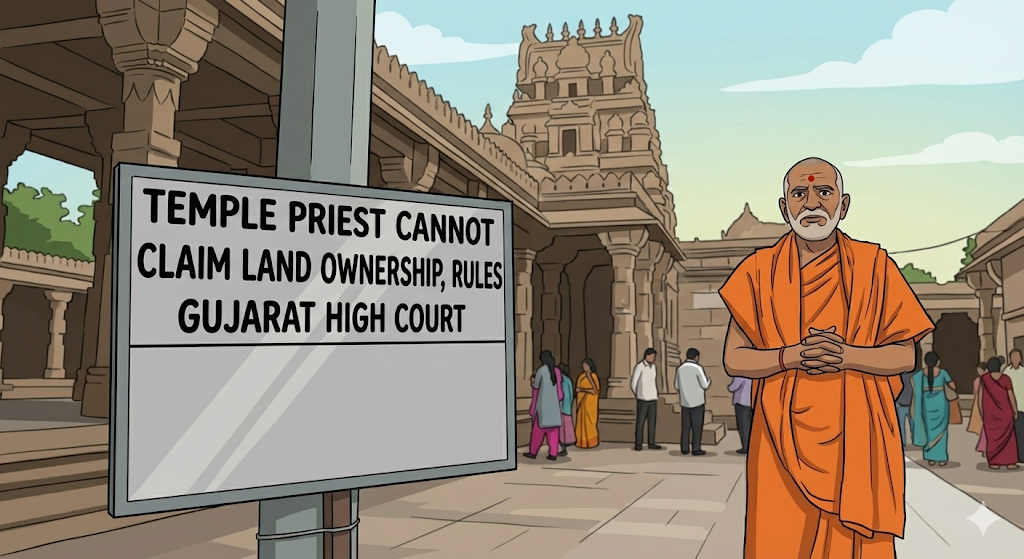
The Gujarat High Court, in a significant ruling on temple land ownership and adverse possession, has categorically held that a temple priest is merely a servant of the deity and cannot claim ownership rights over land by virtue of performing religious duties. The Court clarified that long-standing religious service does not create proprietary rights, especially over public or disputed property.
Table of Contents
Temple Priest Land Ownership Dispute Before Gujarat High Court
The dispute arose from a civil suit involving the unauthorised construction of a Ganesh temple on a public access road, which allegedly obstructed the lawful ingress and egress to the property owned by the plaintiff, Ashaben Kamleshkumar Modi. The access road, measuring six metres in width, was meant for public use and provided entry to the plaintiff’s land.
The trial court and the first appellate court ruled in favour of the plaintiff and directed the removal of the unauthorised temple structure. Challenging these findings, Rameshbhai Umakant Sharma, claiming to be the pujari of the temple, filed a second appeal before the Gujarat High Court asserting ownership through adverse possession.
Gujarat High Court on Temple Priest and Adverse Possession
While examining the appeal, Justice J.C. Doshi observed that no substantial question of law arose under Section 100 of the Code of Civil Procedure. Rejecting the priest’s claim, the Court made it clear that religious service does not translate into land ownership.
The Court observed:
“He is not Bhumiswami (landowner); he is just a servant of deity. A servant thus, has no right to claim that his possession over the suit property is on behalf of his master and matured into title on principle of adverse possession.”
The Gujarat High Court further clarified:
“The defendant was just ‘pujari’, he has no proprietary right over the suit property… he is not holding any possession being notorious possession adverse to the title of the owner.”
Why Adverse Possession Claim Failed
The Court reiterated that for a valid claim of adverse possession, the claimant must establish hostile, open, continuous, and uninterrupted possession against the true owner’s title. In the present case:
- The possession of the temple priest was permissive and linked to religious duties
- There was no hostile intent against the true owner
- No evidence of notorious or exclusive possession was produced
As a result, the adverse possession claim was rejected.
No Ownership Claim by Temple or Trustees
Another decisive factor was that neither the temple trust nor any authorised representative of the deity had asserted ownership over the disputed land. The claim was made solely by the pujari in his individual capacity, which the Court found legally untenable.
Unauthorised Temple Construction on Public Road
The Gujarat High Court reiterated that unauthorised religious constructions on public roads cannot be protected by law, particularly when they interfere with public rights and private property access. Consequently, the second appeal was dismissed at the admission stage, and the lower courts’ orders for removal of the illegal structure were upheld.
Legal Impact of the Judgment
This judgment reinforces key legal principles:
- A temple priest is only a servant of the deity, not a landowner
- Religious service does not confer property rights
- Adverse possession requires strict legal proof
- Public land encroachments cannot be justified on religious grounds
The ruling strengthens property rights jurisprudence and prevents misuse of religious positions to assert unlawful ownership claims.
CASE TITLE: Rameshbhai Umakant Sharma v. Ashaben Kamleshkumar Modi & Ors. (Neutral Citation: 2026:GUJHC:3973)
READ JUDGEMENT